Why Wheel Alignment Has Become Critical to ADAS Performance
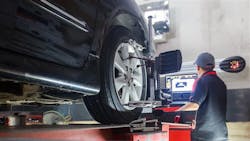
Since the early days of the automobile, wheel alignment has been an important part of vehicle service and repair. It has always been fundamental to vehicle handling, tire wear, and passenger comfort. But today, it has become an even more critical service that technicians provide their customers, and that is because of all the advanced driver safety systems that are incorporated into the modern vehicle. While ADAS systems should not be a foreign concept to today's technician, it's just as important for the technician to have a firm understanding of the foundation these systems are built on, as well as the systems themselves.
Modern vehicles are dependent on a network of sensors. Things like cameras, radar, LiDAR, and ultrasonic sensors are constantly interpreting the world around them. The vehicle needs to use the data these sensors provide to make split-second decisions about what is straight, level, centered, and moving. And the vehicle bases this all on one fundamental assumption: that the vehicle's geometry is correct.
A Game of Inches
In the 2000 movie “The Patriot,” Mel Gibson's character reminds his two young sons to "aim small, miss small" as they wait in ambush for a squad of British Red Coats. ADAS functionality relies on accuracy, and that system accuracy is dependent upon the foundation it's built upon being true. A forward-facing radar module may be mounted correctly to its bracket, its bracket may be mounted securely and correctly to the radiator core support, and the vehicle can have a successful static calibration of that system. But if the thrust angle is off and the vehicle isn't tracking straight down the road, the ADAS systems that rely on an input from that module will not work as effectively as designed. If that forward-facing radar module is even one degree off from the direction of travel, at 100 yards, that module will be off target by more than five feet. At 75 mph, that vehicle is traversing over 36 yards per second, so if you can see why accuracy is important.
Understanding the Technology
To understand why alignment geometry is so important for ADAS performance, it's critical to understand how these systems operate. Every ADAS input—camera, radar, or sensor mounted to a vehicle—is going to be calibrated relative to that vehicle's frame of reference. Basically, that vehicle's centerline, thrust angle, and the level horizon.
When a technician performs a calibration on a forward-facing camera, for instance, they don't just teach the system to recognize a pattern; they also help it define where straight ahead is, where the level horizon is, and what the vehicle considers centered in the lane. If the geometric assumptions the vehicle makes are correct, the ADAS module has a baseline that is reliable to interpret lane markings, oncoming traffic, pedestrians, and other obstacles. If they are not, then every decision the vehicle makes is based on that built-in error. Forward-facing cameras, radar modules, blind spot sensors, and 360-degree camera systems all depend to varying degrees upon accurate base alignment geometry and ride height. ADAS calibrations don't just aim sensors; they help synchronize the ADAS system and the vehicle's physical geometry, and geometry starts with alignment.
The Chain of Accuracy
ADAS accuracy does not start with target boards and a scan tool; it starts with the alignment rack. We have established that virtually every step in the calibration process depends on accurate alignment. Yet not all manufacturers call out a complete four-wheel alignment as step one in the calibration process, or they leave it as an optional step for the technician. Just because the repair a technician performed that triggered the need for an ADAS calibration does not call for a wheel alignment, does not mean that for certain calibrations the alignment should not be checked. How else would the technician know that the vehicle entered the bay with an accurate alignment to begin with? This falls back on the technician to have that firm understanding of system design and overall concept of operation.
Remember, the alignment identifies the geometry, and inputs from systems like the steering angle sensor confirm the driver's intent. It's imperative that the alignment geometry is true and that proper steering angle resets have been made before a target has been placed in front of a vehicle. This chain of events has to happen precisely and to the manufacturer's specifications because when any link in the chain is compromised, the result is an ADAS calibration that appears to have completed successfully, but does not reflect the vehicle's true driving direction. There may not be a fault code set, but the vehicle will not interpret the road as it should.
Proper alignment, verified on level, calibrated equipment, is a critical first step in an ADAS calibration procedure. To treat an alignment as a separate or optional task is only inviting unnecessary risk and headache for the driver and technician.
The Hidden Variables
Wheel alignment data doesn't exist in isolation; this data is a product of suspension geometry, which itself is interdependent on vehicle ride height. For vehicles equipped with ADAS systems, ride height isn't just about vehicle appearance or tire wear. It's a direct input to how cameras, radar modules, and other sensors perceive the world. When the vehicle sits higher or lower than designed, every camera and sensor's aim changes.
Forward-facing radar modules and cameras are calibrated precisely, and a change of a few millimeters in ride height will alter the camera or sensors' aim by fractions of a degree, which is enough to alter its detection field significantly farther or shorter than intended. A vehicle that is heavily loaded in the rear, for instance, is going to travel with a nose high angle of attack, effectively tilting the radar up as well. The radar is now aimed too high, affecting its short-range accuracy, and it could affect its ability to detect closer objects. The same geometry affects camera pitch angle, changing the way the camera interprets things like lane markings. Now, obviously, the loading of vehicles cannot be avoided, but if a vehicle is going to consistently be loaded, additional effort could be made to level that vehicle out under load, keeping equipped ADAS systems online and functioning as designed.
Inputs like ride height sensors are also key components in ADAS systems. A quick look in data stream to verify correct operation can alleviate future headaches for a technician. These sensors are feeding information to the ADAS system, and improper operation could cause an attempted compensation for a false pitch or roll condition.
Many OEM calibration procedures explicitly call for verification of ride height before starting the calibration process. But all too often this step is overlooked. Yet persistent calibration failures or inconsistent system performance can lead directly back to vehicle ride height.
Invisible Offenders
We have well established that inputs like the forward-facing camera and radar modules are dependent upon the vehicle's thrust angle and centerline meshing up. We need the vehicle to travel in the direction the camera and radar are pointed at, or they won't be effective in alerting us to dangers in the vehicle's path.
Many technicians don't spend enough time thinking about the vehicle holistically in terms of mechanical repair. It's not unheard of for a technician to need to drop a rear cradle to gain enough room to pull a fuel tank to replace a pump module or replace a rear differential assembly. Any service that can change the rear toe angles should have an alignment included with the quote, again, to make sure that the ADAS system is being built upon a square foundation.
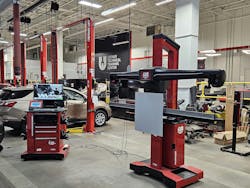
Steering Angle Sensor, Thrust Angle, and the Vehicle's Perception of Straight Ahead
If the thrust angle defines where the vehicle is actually going, the steering angle sensor defines what the vehicle thinks the driver wants to do. For vehicles equipped with ADAS, those two references, vehicle direction of travel and driver intent, must perfectly agree. If they don't, then the system's perception of straight ahead becomes distorted, and accuracy is affected.
The SAS is a key player for many ADAS functions. It feeds data to modules controlling lane keep assist, electronic stability control, adaptive cruise, and collision avoidance systems. Its ability to communicate steering rate, position, and torque over the high-speed network is at the heart of the vehicle's ADAS system.
During ADAS calibration, the SAS value is critical. For accurate operation, the systems need to know where true zero is. The SAS provides the input to tell the vehicle when the wheels are pointed straight ahead, which should correspond with the vehicle's thrust line and geometric centerline. But if the SAS system has failed to be calibrated after a previous alignment, the SAS input is misaligned with the vehicle's true direction of travel.
That misalignment can create some subtle issues:
- Lane Departure Warning might trigger early on one side because the vehicle thinks it's veering when it's actually tracking straight
- Lane Keep Assist may try to constantly nudge the steering wheel to compensate for what it interprets as a drift
- Adaptive Cruise Control could track slightly out of the lane, detecting vehicles in adjacent lanes as potential obstacles when they are not
In short, failure to reset the SAS can cause the ADAS system to believe the vehicle is turning when it's not. After every alignment, the SAS should be recalibrated, a simple step but one that is often overlooked.
It's also worth remembering that the vehicle will cross-check SAS data with that from yaw rate sensors and longitudinal accelerometers. If data from the SAS says the car is turning, but the yaw rate sensor doesn't detect rotation, the system knows something is incorrect. This will often lead to calibration faults or stability control warnings.
Alignment and Calibration Workflow: Best Practices for ADAS-Equipped Vehicles
Every manufacturer will outline their preferred workflow for ADAS-equipped vehicles, but one thing is for certain. ADAS calibration and wheel alignment must be thought of as one singular service. They should not exist independently. We have seen the shift with leading tool and equipment manufacturers combining ADAS and wheel alignment equipment for this very reason.
While OEM-specific variations exist, a general six-step best practice applies to most late-model ADAS-equipped vehicles:
Pre-Scan Documentation. Before any mechanical work begins, connect a diagnostic tool and perform a full system scan. Record any existing DTCs, freeze-frame data, and calibration information. Keep an eye out for historical or inactive ADAS-related faults; they can provide clues about prior calibration attempts.
Many scan tools will compile pre-scans into easily shareable reports, and that leads to the next point: document everything. Keep a record of everything from battery voltage to ride height measurements. A printed or saved report establishes a baseline and protects the shop if issues arise later.
Suspension Inspection. Before you start the alignment, measure and verify ride height against OEM specifications. Make note that you are following OEM ride height measuring procedures as well as thoroughly and correctly inspecting suspension and steering components. Remember, you can't align looseness!
- Verify tire size and inflation pressures
- Note tire conditions and abnormal wear patterns
- Make sure that vehicles with air or adaptive suspension systems are in the correct ride mode for the alignment to take place
Perform a Precision Four-Wheel Alignment. Again, documentation. Always print or save the alignment report; you'll often need it to explain results or validate work.
Steering Angle Sensor Reset. Once the alignment is complete, perform an SAS reset or calibration in accordance with the OEM procedures. This step ensures that what the vehicle believes "straight ahead" is matches the vehicle's geometric thrust line.
ADAS Calibration Whether dynamic or static, now that the chassis geometry is verified, you can perform the ADAS calibration.
- Static calibration requires precise target placement, with a level floor, correct lighting, and correct free space
- Dynamic calibrations rely on favorable road conditions and can fail if those conditions are not met.
Post-Scan and Verification Road Test. After the calibration is complete, perform a post-scan to validate the calibration and then perform a road test to verify system functionality.
Closing the Loop Between Geometry and Technology
As vehicles become more dependent on ADAS technology, alignment has evolved from a basic maintenance task to a precision prerequisite for safety. Every sensor, radar, and camera assumes the vehicle's geometry is correct. If it isn't, every decision those systems make will be built on error. Proper alignment, verified ride height, and accurate calibrations are the foundation of system integrity. When alignment and calibration are approached as one connected process, technicians can deliver vehicles that truly perform as designed. Safe, accurate, and ready for the road ahead.
About the Author
 Erik Screeden
Erik Screeden
Technical and Multimedia Content Director
Erik Screeden is the Technical and Multimedia Content Director for the Vehicle Service & Repair Group. Erik is an ASE Master Automobile Technician with L1, and L4 credentials, who has been in the industry for over 25 years in various capacities. During that time, Screeden was a technician. He started out at a Ford dealership and continued to several independent repair facilities as well as spent time in the specialty aftermarket at a GM-specific performance shop. After his time as a technician came to an end, Screeden transitioned into a role providing scan diagnostic and J2534 tool support. He was then able to parlay his experience as a technician and a support specialist and use that in several technical sales roles.
Don't miss any of Screeden's video content sign up for Autoplay.