Deny It at Your Peril: What 50 Years of Emissions Science Has Taught Us
Key Highlights
- Electric cars were once the most popular vehicles in the early 1900s, favored for their quietness and cleanliness, but internal combustion engines eventually dominated the market.
- Emissions testing, including 5-gas analysis and OBD systems, has played a crucial role in reducing vehicle pollutants and understanding engine health over the decades.
- The article highlights the importance of science and education in automotive repair, emphasizing continuous learning to adapt to evolving technologies and environmental standards.
- Historical figures like Soichiro Honda exemplify innovative engineering focused on solving problems at their root, influencing modern emissions and vehicle design.
- The ongoing debate about climate change and fossil fuel use underscores the need for industry professionals to stay informed and adapt to future technological and environmental challenges.
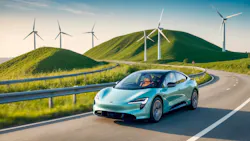
About 20 years ago, I was teaching a hybrid class at a large automotive convention and was asked if pure electric cars were the future. My answer uncovered a division in the automotive repair world. We know more now than we did then in 2006. Let's get up to date.
Like you, I have been referred to as a mechanic until they called me a technician in the late 1970s, since I received a paycheck working on internal combustion-powered vehicles in high school. To understand the future, we must study the past.
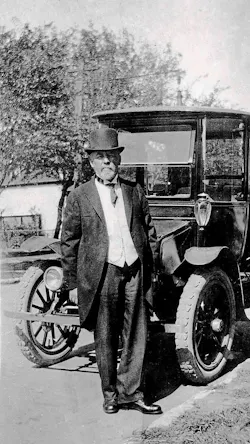
My grandfather, Ed Finacom, was born in 1892 in Washington, D.C., and worked as a mechanic after school. In 1900, 33,842 electric cars were sold in the United States, making them the most popular vehicle type and accounting for 38% of all automobiles on the road (Fig. 1). These electric cars were favored over gasoline cars for being quieter, cleaner, and easier to operate, as they didn't require a hand-crank to start. Electric cars were particularly popular in Washington, D.C. Ed was exposed to internal combustion in the following years. After high school, he moved to Worcester, Massachusetts, to take a job at the electric company, eventually becoming the shop foreman at Mass Electric. His daughter, Shirley, married a mechanic, Raymond, from Ogden, Utah, and he opened a used car lot after World War II. At age 12, my parents divorced, and we all moved from Utah to Worcester, without my dad.
Like many of the technicians I have known over the years, their path into the repair industry has a story. Few of them followed the "college upon graduating from high school" route. I am no exception. Science and chemistry, plus my auto shop class, were subjects I gravitated toward. Little did I know this education would help my long-term career.
Fast forward to 1999. The Automotive Career Development Center opened Oct. 1 as one of many Massachusetts-certified emissions training facilities. Fifteen days later, I paid my deposit to Lundgren Honda to be first in line for a new Insight, the first hybrid offered for sale in America. As I drove my new hybrid and started training technicians in my local area, the education I had lacked was supplemented by Aspire, a training program located near Philadelphia, a few years earlier. It was good stuff.
Massachusetts started testing vehicle emissions in 1983, making it one of the first states in the country to do so. Massachusetts has the highest percentage of adults with bachelor's degrees or higher in the nation. Around 44% of adults have a bachelor's degree, and approximately 32% have a graduate or professional degree. That is 76%. The high school graduation rate is also high, at over 96%. I have a high school diploma. I must have brought that average down a bit. They say people here are "wicked smart"; now you know why. Love the accent.
We can all agree that a top-notch technician must have above-average intelligence to understand the complex systems we work on. What about formal education?
We must include the Honda company and Soichiro Honda, the founder, in this article. He was clear with his engineers: to fix any problem with his vehicles, go to the root cause. They did in model year 1975 with the Compound Vortex Controlled Combustion design. The fuel was burned at a lower temperature and at a slower rate. A catalytic converter was not needed until 1981 in most states. Good engineering, chemistry, and not making pollution to begin with were Honda's strengths. I was in my 20s and soaking up technology like a sponge.
5-Gas Training

Without getting into complex molecular formulas, your 5-gas analysis training (Fig. 2) most likely started—depending on your age and where you worked—when your shop had to fix a "failed emissions" related repair. Many well-populated areas of our country set up inspection stations, often including safety measures, to test the tailpipe gases of vehicles using gasoline. If you have never worked in an "emission-regulated area," there are still books and videos to get you there.
The five gases tested on an internal combustion engine's exhaust are carbon monoxide (CO), carbon dioxide (CO2), hydrocarbons (HC), oxygen (O2), and nitrogen oxides (NOx). A 5-gas analyzer is used to measure these gases, which helps diagnose air/fuel ratio problems, combustion issues, and other engine malfunctions to ensure the vehicle meets emissions standards.
- Carbon monoxide is a deadly gas produced from incomplete combustion caused by a rich mixture.
- Carbon dioxide is a product of complete combustion.
- Hydrocarbons are unburned fuel particles that react with sunlight to cause photochemical smog.
- Oxygen is a measure of air in the exhaust, which can indicate a lean or rich condition or an exhaust leak ahead of or near an O2 sensor.
- Nitrogen oxides are created at high combustion temperatures. NOx adds to smog.
Of the five gases, three were known pollutants: CO, HC, and NOx. Older technicians can tell stories about CO, as it would produce a severe headache if you ran older cars in the shop on a day when the garage door was closed. We all joked about "killing a few brain cells."
What was the EPA's Viewpoint?
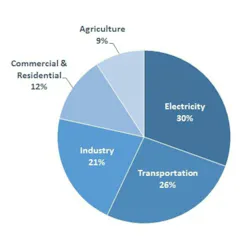
Some of the information below was gathered by ACDC from the Environmental Protection Agency's website prior to its recent removal.
This pie chart (Fig. 3) shows total U.S. greenhouse gas emissions by economic sector in 2014.
Total greenhouse gas emissions in 2014 were 6,870 million metric tons. One gallon of gasoline weighs approximately six pounds. Burning one gallon of gasoline produces about 19.6 pounds of carbon dioxide. This is due to the carbon in the gasoline combining with oxygen from the air during combustion, which increases its weight.
From the EPA's website: "Greenhouse gases trap heat and make the planet warmer. Human activities are responsible for almost all of the increase in greenhouse gases in the atmosphere over the last 150 years. The largest source of greenhouse gas emissions from human activities in the United States is from burning fossil fuels for electricity, heat, and transportation."
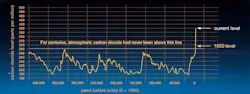
This link is still available on NASA's website: https://science.nasa.gov/earth/explore/earth-indicators/carbon-dioxide/. The graph below (Fig. 4) is also from the NASA website currently. It shows an increase over time. Looks like the problem started when I was born.
Science and Chemistry
Being born way before we regulated emissions, my career has had a ringside seat in controlling pollution. Massachusetts was my petri dish.
When any gas is too high, what do we do? We follow the data presented by a scan tool and other means, but the most important tool is a 5-gas analyzer. Today, that piece of equipment is rarely used, as OBD information is faster and less expensive. My nine years as the owner and lead trainer at the ACDC, my second business, started when enhanced inspection and maintenance rules were adopted in my state. All cars and light-duty trucks were tested on a chassis dynamometer. Our shop had a dyno installed in 1999, the same year we opened ACDC. The class was 80 hours long, one night a week. We were booked solid for years. Students would bring in their customers' failed cars, and we would run the dyno test again to confirm the original test and put together a strategy. If we didn't get the numbers down, we kept at it, learning as we went. Even though we had worked all day, the energy was there to fix these failed cars and get them running clean again. We all discovered that understanding the science of chemistry was the key. High CO? It needed less fuel or more air. What about an exhaust leak a few inches behind the last O2 sensor? Problem found. Soft carbon in the combustion chamber, high HC. De-carbon the engine. Fixed. This went on for years. Logic, science, and reason were the three principles we taught. As of Oct. 1, 2008, the program shifted to "OBD-II testing only." Tailpipe testing on a dynamometer ceased, and 5-gas testing, as a way to solve problems, went away as the equipment broke down and the companies that sold them went out of business. Today, it is a bit of a lost art.
What is interesting about science is that it self-corrects. Math is a science that is never questioned. All other disciplines are subject to review. If a scientist comes up with a report that carbon dioxide warms the planet, it will be challenged. Carl Sagan (Fig. 6) was a vocal advocate for climate change awareness, testifying before Congress in 1985 about the dangers of the greenhouse effect and human impact on the climate. He used the study of other planets to explain how Earth's atmosphere could be dangerously altered by increased greenhouse gases. Nothing serious was done. Over 50% of our oil in the 1980s was imported, and there were no other fuels for transportation available. Carl's warnings emphasized the potential for widespread suffering, and he stressed the importance of international cooperation and taking responsibility for future generations. He was challenged by other climate scientists, as he should have been.
I was in my mid-30s, running my independent Honda shop and attending college at night. My lack of education was increasingly an issue at work, so more education was needed. When I registered at Becker College in my hometown, the person behind the desk noticed my balding head and commented, "You don't look like the average college student." I explained why I was there, and she asked how my business was doing. As we chatted, she suggested I audit the classes. Half price, no required classes, but no degree. I needed an education, not a diploma.
It may seem hard to have two conflicting thoughts in your head at the same time, such as CO2 traps heat in our atmosphere, and this sudden rise in global temperatures on land and in water is normal. This conflict happens when we know we have checked "everything," but the car will not start. Case in point: When the Prius first came to America in 2000, it had no 12-volt starter motor. When the Toyota cranked over the gas engine, it did so quietly and fast. The fuel gauge was often inaccurate. Many a technician was fooled by a car they thought was idling, but in reality was still being cranked over due to a lack of fuel. It got worse if the camshaft was 180 degrees off. Once the problem was found, only then did your opposing realities become one. The planet is overheating. Our 50 years of cleaning up the tailpipe has worked wonders. The CO is now CO2. The HC is now CO2 and water vapor. The NOx is now CO2 and nitrogen. If carbon dioxide wasn't produced in such large quantities, the planet would still be about the same temperature it was 150 years ago. Sadly, the problem is real in Iowa and Utah, California and Massachusetts, the Netherlands and Zimbabwe, Australia and Brazil.
This is a subject that will be debated by those in our industry who want fossil-fueled engines to stay. The rest of us will stay quiet and go about our work. The car manufacturers that build the vehicles we work on know the science. It has been about 25 years since that little Insight showed up. In America, we have over 10 million high-voltage motorcycles, cars, and even Class 8 trucks using electric motors to add power to the wheels. What will the next 25 years bring us? What was my answer 20 years ago that created such a stir? "We have no choice. CO2 is a problem, and we need to stop burning fossil fuels."
Deny it at your peril.
About the Author
 Craig Van Batenburg
Craig Van Batenburg
Craig Van Batenburg is the CEO of ACDC, a hybrid and plug-in training company based in Worcester, Mass. ACDC has been offering high voltage classes since 2000, when the Honda Insight came to the USA. When EVs were introduced in 2011, ACDC added them to their classes. Reach Craig via email at [email protected] or call him at (508) 826-4546. Find ACDC at www.FIXHYBRID.com.