Balancing yesterday, today, and tomorrow: Bosch's vision for the automotive aftermarket

As the automotive industry navigates technology change and implementation, the question of how to serve both legacy vehicles and emerging technologies has become critical for aftermarket suppliers. Todd Hertzler, regional president of North America for Bosch Mobility Aftermarket, has made it his mission to ensure the industry doesn't leave behind the millions of vehicles still on the road while embracing innovation. In this interview, Hertzler discusses Bosch's commitment to balancing the past, present, and future of automotive repair and maintenance—from maintaining choice in legacy parts to developing new age diagnostics, calibration solutions, and AI-powered tools that will drive shop profitability for years to come.
Todd, while some aftermarket suppliers have reduced their focus on legacy vehicle products, what's Bosch's philosophy on maintaining choice for the growing population of older vehicles still on the road? And how do you balance that with innovation?
Todd Hertzler: We know there is a lot of concern in the market about diminishing choice, especially around legacy technology and the internal combustion engine. As an innovator in a lot of that technology, not just a player, but we were (a front runner) in developing technology like gasoline direct injection. We are absolutely committed to continuing to invest in maintaining that legacy technology. We fully commit to being the last person standing on internal combustion engine technology, and that's really important for our customers to hear.
A lot of what you see, hear, and read about in the papers is the sexy stuff—technology we're talking about for the next five, 10, 15, or 20 years. But that doesn't always help this huge car parc that we have in North America, which is the largest, and ensuring that our customers stay on the road with high-quality, value-driven solutions.
That doesn't just mean saying you commit. It means you have to continue to invest in legacy technology. That's the part that sometimes gets missed. It's not just keeping that line there. You've got to keep the line state-of-the-art. You've got to improve productivity. You've got to continue to reduce costs. This, in its own right, requires investment. We at Bosch are 100% committed to continuing to invest in that technology and providing our customers with high-quality parts at a good price.
What about Bosch's current offerings in diagnostics and calibration—can you talk about how those fit into what you're doing right now?
Hertzler: When I think about the present, I think about diagnostics and diagnostics services, remote diagnostics, and technology like ADAS calibration. These are not technologies five, 10, 15, or 20 years down the road. These are today. When I think about shop owners and technicians and revenue streams for our industry, so much of it will be driven by things that you don't necessarily see, feel, or touch. It's calibration, it's diagnostics. This business is really now in the moment and present for us.
The other piece I would look at is combining the past and the present—our OTC brand, Owatonna Tool Company, which is celebrating 100 years this year. Workshop tools and equipment have been a legacy for us for a very long time. Whether it's 1,000-pound jacks or a wide variety of other tools and equipment, we have put them into the market and will continue to, and they are focused on quality and, most importantly, safety. Safety is such an important part of quality tools and equipment. This is an area where we are especially focused. With this rich history that we have with Owatonna Tool Company and continued investments that we're making in new product introduction, this is something we're really looking forward to revitalizing here for North America.
We had OTC debut 80 new product numbers at APEX and SEMA. The (latest) tools significantly expand on vehicle coverage. Technicians are seeing increasingly varied vehicle makes and models in their shops, so coverage is really important to our customers and to technicians. A focal point for many of these new products is making the service process simpler, safer, and more convenient for technicians. Two examples are our S06G, which is our 6-ton jack, and the S03G, which is our 3-ton geared jack. They not only provide universal support for most vehicles, but they also allow technicians to feel comfortable, safely standing beneath the vehicle without having to crawl underneath it. This is really important to our customers—safety and convenience-based products.
How does Bosch address shop owners' concerns about parts availability?
Hertzler: We definitely hear and sense the concern in the market about long-term supply commitments, especially around fast-moving trade goods like starters, alternators, spark plugs, and brakes, in addition to gasoline and diesel technology. We know our customers want options, not just from multiple suppliers, but also in terms of good, better, and best. Whether it's fast-moving trade goods like starters, alternators, spark plugs, and brakes, or gasoline or diesel technology, offering a variety of solutions is key. Not just that the parts are available, but that there could potentially be a part that fits multiple use cases in terms of pricing and durability. This is something we have staked a claim to for the past 50 years and will continue to.
Brake pads is a good example where Bosch is expanding and investing, not just in new products, but also in new markets. The release of our heavy-duty brake pads is another example of looking at new markets where we can continue to support these older and aging vehicles.
We are committed to servicing that technology, but not just servicing it, investing in it. That investment is an absolutely critical part of being a player, not just today, but for years to come.
How is Bosch's technician training and development approach different?
Hertzler: I look at it from a few different areas. One is our workshop loyalty program, called Bosch Modules. In addition to providing incentives to purchase Bosch parts, tools, equipment, and diagnostics, it also offers a wide variety of different trainings, classes, and supporting materials for technicians. This is a really important part of ensuring that technicians have the information at their fingertips to do the job right and do it quickly. That's a big part of technicians remaining competitive.
We understand that technicians in many cases have flat rates, which means it's that much more important that the vehicle gets on and off that lift as quickly as possible. That starts with having the right part, the right diagnostics, and then the right instructions on how to fix the issue. We capture this between our parts, diagnostics, tools, workshop equipment, and the additional services that we provide through our Bosch Module program. We're supporting the next generation of technicians to ensure that they are competitive and that the shops remain profitable.
If I think about it a little bigger, I think about Bosch's engagement with the University of the Aftermarket. We are now a lifetime trustee of the University of the Aftermarket, which is a really cool organization that supports technician training and brings that next generation of technicians and industry professionals into the automotive aftermarket through scholarships, trainings, and networking. I've been involved in this since I took over as head of sales back in 2020, and have been lucky enough to see it come to fruition with us being a lifetime trustee. This is an important part, not just for Bosch, but for everybody in our industry. We are continuing to support the next generation of people we want to bring in and the next generation of talent that is going to make our industry more successful for the next 25 years.
Let’s discuss Bosch’s Super Technician. How does it help auto repair shops?
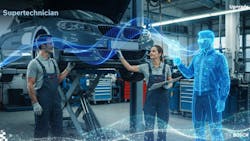
Hertzler: Super Technician is really cool. We've talked a little about legacy technology, current technology and diagnostics, remote diagnostics, and calibration. And then we think about how we're utilizing artificial intelligence going forward. Bosch Super Technician, which we debuted at CES in January of this year, is a step in that foray into the next generation around artificial intelligence, which we think is going to transform shop operations and the aftermarket repair industry as we know it.
What it is designed to do is help repair technicians work smarter, diagnose faster, and stay ahead of the curve as vehicles continue to grow more complex, but do it in real time without having to step away from the vehicle or disrupt the flow of the repair process. They can do it in real time and upload files and basic information. It's going to expedite diagnostics by instantly sifting through tons of data to align with issues that were being presented, whether it's visual, audio, or other, with known diagnostics and quickly illuminate the fix.
For us, it's about speed, but it's also about sifting through an unbelievable amount of information that's already available to help technicians diagnose quicker. This, we think, is a real game changer.
What happens to shops that don't adopt these AI diagnostic tools? Are they at a competitive disadvantage?
Hertzler: With any new technology, it's got to augment what we're doing today. We're not saying that it's going to take the place of the technician. What we're saying is that you can utilize the expertise and experience of the technician and not just that technician, but potentially thousands of technicians around the world who have already seen and diagnosed similar issues. The fact that you now have access to a lot of that data helps any technician be quicker and faster.
The key performance indicator is the amount of time in the turnaround for a repair on a vehicle. It doesn't take very long to convince shop owners or technicians that if you can significantly reduce the amount of time it takes to do a repair, you're going to be more profitable for your shop and your technician. Once you demonstrate this one time, the adoption of AI for anybody who's been using it once, you can see how much time it can save you and the overall improvement in the quality of the work the first time. I think we're going to get some believers very quickly.
There may come a time when AI is a prerequisite for the ability to service those vehicles. Our genuine hope is that we can make these tools so user-friendly and have them become so ingrained in the day-to-day work of shop owners and technicians that it won't be a question of if, but only a question of when.
Remote diagnostics is a significant shift from traditional in-shop repair. How does Bosch see this technology helping auto repair shops rather than threatening their independence?
Hertzler: Remote servicing is the next great thing in diagnostic service. When we talk about advancements in remote diagnostic capabilities, it's going to centralize the repair and maintenance experience for drivers and technicians together. It allows technicians to manage servicing in-house as opposed to outsourcing. That's a big thing for shop owners and for technicians. When you can manage the servicing within your shop without having to outsource this, it helps shop owners be more independent, more profitable, and more productive.
As they complete repairs on a vehicle, technicians can remotely loop in a trusted partner to access necessary information and handle cloud-based diagnostic servicing from afar, all while the car is in the shop and while potentially other repairs are being made. This is a game-changer. It dramatically increases the productivity of the shop and the ability for the shop to keep more of the servicing in-house, which is what we're helping shop owners do.
What does the 100-year milestone mean to Bosch?
Hertzler: It's important. Anytime you celebrate 100 years of anything, it means that you've sustained multiple generations and that your brand is as strong as any headwind you might face in the market.
We have a rich history at Bosch. Whenever we hit a milestone, whether that be 25, 50, 75, or 100 years, we try to celebrate it because there's a lot of work and effort that goes into maintaining brands. A lot of brands come and go, and ours has stayed. For that, we're very grateful. But we're also very proud.
About the Author

Chris Jones
Editorial Director
Chris Jones is group editorial director for the Vehicle Service & Repair Group at EndeavorB2B.
A multiple-award-winning editor and journalist, and a certified project manager, he provides editorial leadership for the auto care industry's most trusted automotive repair publications—Ratchet+Wrench, Modern Tire Dealer, National Oil & Lube News, FenderBender, ABRN, Professional Distributor, PTEN, Motor Age, and Aftermarket Business World.
Subscribe to receive news and updates from any of these industry-leading brands.