14 Questions with Jason Powell, Motor Age Training/ASE Master Automobile + L1 Technician of the Year
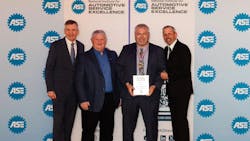
Jason Powell, Motor Age Training/ASE Master Automobile + L1 Technician of the Year, is a training center manager and technical training instructor at Kia. With 25 years of hands-on automotive service experience and a passion for developing the next generation of technicians, Powell has become a driving force in the industry. His journey from wrench to mentor — and his dedication to elevating technician training through ASE certification — reflects a career built on lifelong learning, persistence and a genuine commitment to the future of automotive service. He sat down with Motor Age's Chris Jones to discuss his life in the automotive industry.
Motor Age: You rebuilt your first muscle car with your dad at age 14. How did that early, hands-on experience shape your approach to training other technicians today?
Jason Powell: That experience is what got me excited about cars to begin with. It helped build my passion for the automotive industry as a whole. I think the passion I gained from that has carried over into my training. When I teach a class, it's not just teaching a class — I want to make it the best opportunity for technicians to gain knowledge, advance their careers and get excited about what they're doing. I want to help students become better at what they do so they can get good experiences down the road, enjoy the field, and love it enough to continue until they pass it on to the next generation.
Motor Age: Now your son's 14. How does that feel to have it all come full circle?
Powell: It's awesome. Some of my proudest work is being able to work with the kids. We're working on a truck right now — a '72 F-100 — and we've ripped everything out of it. He's helped me from day one, tearing it all apart, changing out the suspension with a different one, cleaning the frame, and painting it. We put a different modern driveline in it, and he helped me with the electronics side, hooking up the grounds and wiring up the module. It's been a blast and really cool. It's hard in a way because it takes you back to being 14 again, but all I can do is enjoy it and hope that maybe he gets to do the same thing for his kids.
Motor Age: You've spent 25 years in the automotive service industry. How has the field changed most dramatically in your career, and how are you preparing the next generation to adapt?
Powell: The field has changed dramatically. Technology has changed substantially. Electronics are everything — you have to know electronics to do this career. At this point, everything's computer-generated. Everything comes off some sort of module. Brake systems are using electronics for wear indicators and everything else. It's come a long way over the last 25 years. I'm also seeing much younger generations coming into the field and a lot of females entering the industry, which I think is moving in a good direction. But definitely, there's a lot more electronics than there ever was. You've got to be good with electronics.
Motor Age: You've transitioned from dealership technician to training center manager. What prompted that shift, and how did your hands-on experience influence your ability to teach?
Powell: When I started my career in 2000, I was fortunate to work with a couple of technicians who had been doing it for a long time — master techs at the dealership with 15 to 20 years in the field. They guided me and let me know that while I loved the automotive career and wrenching on cars, at some point, it would become physically too hard. That sank in, and from there, I was always looking ahead, knowing that around 45 or 50 I'd need to consider what's next. I started looking at managing a service department or moving into training. As I progressed through my career, the opportunity came up earlier than I expected, but the stars aligned, and it worked out really well.
As far as the classroom side goes, I didn't have presentation skills at first, and another instructor worked with me. But I had real benefits from working in the dealership for 16 years. Technicians could relate to me. I can relate to the situations they're in, which I think made me a much better trainer overall. I'm not just presenting material — I'm sharing experiences, and I know what situations they face. I know how to help them. So yes, I think it made me a lot better as an instructor.
Motor Age: You won the Kia Skills competition twice consecutively and competed in three worldwide competitions. What was that experience like, and how did those victories impact your career trajectory?
Powell: The experiences were fun and a good time, but completely out of my comfort zone. Fixing a car in a stall is different from fixing it in a bay where there are cameras and a clock, with a guy standing next to you with a clipboard. But it did help me advance my career because it got me in front of higher-up people in Kia Corporation who got to know me better. The first two times I made it to Korea, I won the U.S. competition. I spent a lot of good time with higher-up personnel. The third time I went over there, it was right around the same time they were looking to hire somebody, so it just worked out really well.
Motor Age: ASE certifications clearly hold deep meaning to you. How do you instill that same respect for certifications into the technicians you train?
Powell: That can be a challenge. Every dealership, every brand, and every company does training differently. It's hard to get a good feel for somebody's skill level if they're applying for a job. But ASE certification has always been the top-level certification. When you see ASE certification on a resume or an application, you get a pretty good feeling that the person knows what they're doing. He's taken a standardized test. It builds more respect for that person, and the same goes for customers. That's what I try to help my technicians understand — when you have that ASE certification on your shirt or on the sign out front, the customer is going to have that same comfort bringing their vehicle in. It doesn't change you as a person, but it lets customers know the quality of technician that you are. It gives them confidence in you.
Motor Age: How important is ASE as an industry standard? Do you think it's critical?
Powell: I wish more people would notice it and get into it. There's a lot of variance out there in the automotive industry, and it takes some sort of standard to help dealerships and shops find the right people for the job and pay the right people for the job. You don't know what you have until someone walks in the door and starts picking up the wrenches. If ASE certification is on someone's resume, that makes a difference. It gives you comfort knowing that person has a knowledge base at a certain standard, as opposed to someone with training from another manufacturer, where you have no idea how good that training is or how in-depth it was.
ASE certification is really critical for the industry. I think it needs to continue and grow throughout the business. It needs to stick around and be the standard. I think more people need to invest time in certification.
Motor Age: What's your message to technicians who are hesitant to pursue or continue certifications or take advanced tests?
Powell: You never know what tomorrow's going to bring. You have the opportunity to test yourself and make sure you're keeping up with the standards. In this business, it's easy to get comfortable and feel good about what you do, and next thing you know, five years later, you've fallen behind. You didn't keep up with technology. Having an ASE test that you can recertify in helps you keep up with technology and double-check your knowledge to find your weak spots. I think that's very important.
Motor Age: As a training center manager, what's your philosophy for developing next-generation technicians?
Powell: I feel it's difficult to train technicians if they (come into) the wrong situation. I try to be patient with technicians and encourage them, showing them the good sides of the industry. There's so much on social media that makes it easy to see all the bad-mouthing of the field, but there's so much good in the industry, too. I try to show technicians — both guys and gals — some of those good sides.
If they have questions related to training or how to handle a situation, I'm an open book. If someone's thinking about getting out of the field or looking at plumbing because it's too hard or they can't handle flat rate, sometimes they just need to sit down and have a conversation about their processes and habits and how they can be successful. Really, a lot of times that's what they need — encouragement and confidence.
Motor Age: The automotive industry is going through big technological changes with electrification. How are you updating your training curriculum to address these shifts?
Powell: We've updated our drivability classes very recently. We've created new high-voltage classes. We have an EV class now and an advanced EV class for things like internal battery repairs. That has to be updated regularly because the EV market and EV products are changing so rapidly.
I'm also monitoring other company materials. You can't just focus on what your brand is doing because every brand does it so differently. What brand X or Y is doing, your group might be doing in a year or so. I try to stay up on all of it. We've updated our training substantially — we've extended our electrical program, grown our high-voltage program, and advanced our drivability program. It's been hectic, but also a lot of fun.
Motor Age: What does winning the Motor Age/ASE Master Automotive L1 Tech of the Year award mean to you personally and professionally?
Powell: To be recognized by Motor Age and by ASE is hard to put into words. It's pretty incredible. There are two major names in the business, and I'm not even sure I would be noticed in a room with so many talented guys. So it's pretty awesome. I'm very grateful and very appreciative. I'm just excited they found me. It means a lot.
Motor Age: Where do you see yourself in your career in the next five years, by 2030?
Powell: I love teaching, so I don't see a whole lot changing. I want to stick with training. I wouldn't mind someday branching out and doing some videos on my own or something of that nature outside of the dealership technician world — try to hit a wider audience. But if I were where I am now in five years, I'd still be pretty happy with myself. I enjoy it.
Motor Age: If you could change one thing about how the automotive industry trains technicians, what would you change?
Powell: I wish we could have more time with technicians. That's the hardest part. Technicians are on flat rate when they're at training centers, so they're not making the dealership money. I wish we had a little more time to spend with them.
Motor Age: What's the most rewarding aspect of your job, and what keeps you passionate about training other people?
Powell: That one's easy. The most rewarding part is when I've trained a technician — let's say in electrical — they leave my training center and come back two months later. The first thing they want to do is tell me how excited they are about an electrical problem they had. They never understood electrical before, but now they get it. They got a car back and were able to diagnose it and fix it right the first time. To see them glow from it, to see the pride in them, and see them excited about their accomplishments — that makes them want to keep coming back for training and keep pushing forward in their career. That's why I do this job. I love that part
About the Author
 Chris Jones
Chris Jones
Editorial Director
Chris Jones is group editorial director for the Vehicle Service & Repair Group at EndeavorB2B.
A multiple-award-winning editor and journalist, and a certified project manager, he provides editorial leadership for the auto care industry's most trusted automotive repair publications—Ratchet+Wrench, Modern Tire Dealer, National Oil & Lube News, FenderBender, ABRN, Professional Distributor, PTEN, Motor Age, and Aftermarket Business World.
Subscribe to receive news and updates from any of these industry-leading brands.