Editorial: Organize your tool chest: Time is money.
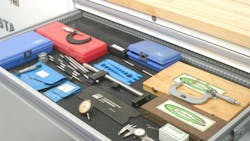
A technician’s tool arsenal is the lifeblood of his or her trade. An adaptation of an old military term can appropriately be applied: These are my tools. There are many others like them, but these are mine. Without them, I may be useless. Without me, my tools are useless. The combination of my tools and my training results in a force to be reckoned with.
A typical tool chest may contain hand tools, such as open-end and combination wrenches in both fractional and metric sizes; six-point and 12-point sockets, both short and deepwell in fractional and metric sizes; male hex wrenches and male and female hex bits. It may contain an array of sizes of flat blade and Phillips screwdrivers; 1/4-drive, 3/8-drive, 1/2-drive, and 3/4-drive ratchets; ratcheting micrometer and digital torque wrenches; torque/angle torque wrenches; hammers, etc. Add to this a plethora of specialty tools that apply to the type of work the individual tech must be able to address, as well as power tools including pneumatic wrenches and impacts, cordless wrenches and impacts, hand-held pyrometers, soldering guns, crows-foot and offset wrenches, screw extractors, punches and drifts, chisels, etc. On the electronics and scan tool side of the arsenal, consider multimeters, jumpers, multi-make, and make-specific scan tools. The list goes on and on (and on).
Having the appropriate tools, from the most simple to the most advanced, is obviously important. However, having immediate access to a specific tool in a timely manner is also important. Maintaining a clean and well-organized tool chest is key. If a tool chest is disorganized, the tech can waste valuable time when searching for a specific tool.
When you see a tool chest that is organized (all fractional sockets clean and in size-graduated order, all metric sockets organized similarly, etc.), that is a clear indication that the tech is an organized professional and ready for any task at hand. If a tool chest is a disaster (dirty, greasy tools, crammed into drawers in a jumbled heap with no clear organization), that’s an indication of a tech who may not be detail-oriented, wastes time, and perhaps cannot be relied upon to boost profits for the shop and has the potential for shoddy work.
A pro tech takes the time at the end of each workday to clean his or her tools and place them back into the tool chest in proper location and order, in preparation for the following day.
Keep tools clean and well-organized. Time is money.
About the Author
 Mike Mavrigian
Mike Mavrigian
Motor Age Editor
Mike Mavrigian has written thousands of automotive technical magazine articles involving a variety of specialties, from engine building to wheel alignment, and has authored more than a dozen books that crisscross the automotive spectrum. Mike operates Birchwood Automotive, an Ohio shop that builds custom engines and performs vintage vehicle restorations. The shop also features a professional photo studio to document projects and to create images for articles and books.