ASE Education Foundation Survey Reveals Technician Pipeline Leaks—and What Closes It
Key Highlights
- Only 43% of high school automotive students would choose the program again, with many interested in truck, diesel, or collision repair instead.
- A quarter of students drop out after their first year, citing lack of career clarity and scheduling conflicts as primary reasons.
- Local industry visits are infrequent, with only 30% of students experiencing direct engagement from shops or dealerships, affecting retention and career motivation.
- Over 50% of graduating seniors plan to leave the automotive path, but students with work experience are nearly twice as likely to stay in the industry.
- ASE-accredited programs have higher student satisfaction and recommendation rates, emphasizing the value of industry-recognized credentials.
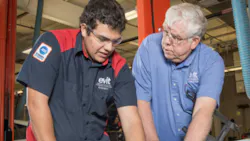
The ASE Education Foundation has released findings from its 2025 ASE Student Survey, and the data offers a clear picture of where automotive programs are losing students—and what's making others stay in the industry.
The results were presented during an update at the Automotive Training Managers Council conference in Ann Arbor, Michigan, on April 15. The report comes as the Foundation continues its work accrediting programs, certifying entry-level students, and connecting industry partners with the schools producing tomorrow's technicians.
By the Numbers
The Foundation's 2024-2025 data shows the talent pipeline it supports: 1,812 programs hold ASE-accredited training status, serving 125,297 students across 1,949 schools in 51 states and territories. Of those, 76,106 are high school students, and 49,191 are in college programs.
During the same school year, 50,249 students earned ASE Entry-Level Certifications, and 1,754 high schoolers earned the G1 Maintenance and Light Repair credential by passing all eight automobile entry-level tests. The Foundation estimates 54,311 entry-level technicians completed two or more years in their program and are ready to enter the workforce part-time or full-time.
But the survey results show those numbers could be considerably higher if a few holes were patched.
Students Aren't Always in the Program They Want
Among high school students enrolled in automotive programs, 43% said automotive is the program they would choose if given the option. That leaves a majority sitting in auto classrooms while wanting something else—most notably truck and diesel, which 23% said they would have selected instead. Collision repair and refinishing drew 12%, welding 6%, and a mix of other paths made up the remainder.
For instructors and industry partners, these findings are significant: roughly one in four students in an auto program may already be more interested in heavy-duty work, suggesting opportunities for diesel-focused industry partners to engage earlier and for schools to broaden program offerings where demand exists.
A 25% Drop-off After Year One
The survey found that 74% of high school underclassmen plan to take the next auto, truck/diesel, or collision class the following year. The other 26%—about a quarter of underclassmen—do not.
When asked why, 26% said they don't see a career path for themselves in the field. Tied at 26% was the fact that other required classes were crowding the schedule. Another 13% said the program wasn't what they hoped for or expected, while 8% said the next class isn't even offered at their school.
The career-path concern carries particular weight because it matches findings from the broader industry's 2026 Voice of Technician Report, where working technicians flagged the same gap—clear, documented career growth—as a top unmet need.
Local Industry Presence is Critical
Only 30% of students reported that a local shop or dealership had visited their program or presented at their school during the year. Another 13% had visits from former students now working in the field. The most common visitors were community college programs (25%), post-secondary technical schools such as Lincoln Tech, UTI, and WyoTech (21%), and military recruiters (16%).
The Foundation's takeaway: local industry involvement directly impacts student retention, and most students simply aren't seeing the people who would hire them.
More Than Half of Seniors Leave the Path
Among graduating seniors, 26% plan to continue their auto, truck/diesel, or collision education after high school, and 16% plan to work full-time in the field. Combined, that's roughly 42% staying on the transportation service path.
On the flip side, more than 50% of graduating seniors plan to leave for other career opportunities, with 15% going to community college or technical school for a different field, 12% heading to a four-year college for an unrelated major, and 19% reporting other plans.
Work Experience is X-Factor
The most actionable finding in the survey may be the impact of part-time work. Among graduating seniors already working in transportation while still in school, 71% plan to continue down that career path after graduation. Among seniors not working at all, only 37% plan to continue. Among those working outside transportation, just 34% plan to stay.
This means that students who get real shop experience while still in school are nearly twice as likely to stay in the industry as those who don't. For shop owners and dealership managers wrestling with hiring, here’s the takeaway: part-time hires aren't just labor, they're retention.
Accreditation Works
The survey also measured student satisfaction by program type, asking how likely students would be to recommend their training program to a friend. ASE-accredited programs posted a Net Promoter Score of 41%, compared with 23% for non-accredited programs.
At the high school level, 59% of students in accredited programs gave their program a top rating of 5 out of 5, versus 45% in non-accredited programs. At the college level, the gap held steady at 61% versus 56%.
Where the Foundation is Pushing Next
The Foundation continues to advance a five-step framework for moving students from classrooms to careers: introducing automotive concepts and STEM lessons in grades 6 through 8; using ASE program accreditation to focus training on industry-valued skills; validating training with ASE Entry-Level and OEM certifications; expanding work-based learning through job shadows, internships, and apprenticeships; and using the foundation's Adopt-A-School and mentor training programs to help shops attract and keep young workers.
For shop owners and instructors looking at the survey data, the message is clear: the technician pipeline isn't broken at the entry—students are showing up. It's leaking in the middle, where career clarity, industry presence, and real work experience determine who stays and who walks away.