Building Tomorrow's Workforce: Tackling the Talent, Recruitment, and Retention of Young Technicians
Key Highlights
- Social media platforms like Snapchat and YouTube are effectively used to attract high school students and showcase automotive programs.
- Building strong relationships between shops and schools through regular communication and industry involvement is crucial for talent development.
- Creating a positive, family-oriented workplace culture helps retain technicians and reduces turnover.
- Industry and educators must actively recruit and promote automotive careers, with shop owners participating in community and school events.
- Innovative outreach, including open houses and community projects, generates excitement and interest among potential students.
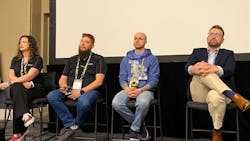
Tim Dwyer, VISION Education Committee Chair, moderated a panel discussion on Friday, March 6, at the VISION Hi-Tech Training and Expo Educator Think Tank. The panelists included Liz and Keith Perkins, owners of L1 Automotive; Gerrot Jacobson, an automotive technology instructor at Hawkeye Community College; and Jay Goninen, founder and CEO of Wrenchway. Together, they discussed strategies for attracting, educating, and retaining young technicians in the automotive aftermarket.
This story has been edited for brevity.
What are You Doing to Attract Talent?
Gerrot Jacobson: We use social media to our advantage. If you went to our page right now, you would almost think that Hawkeye Community College is a tech college that specifically teaches nursing and automotive. That's pretty much all you're going to see. We're not posting students playing in the courtyard or smiling at each other at lunch. I took a picture of some students with greasy hands the other day. (I don't send it to Facebook immediately; I let our social media team scrub it.) And we're all over Snapchat. Students use this stuff. The age group that we're targeting uses this, so use it to your advantage.
We send stuff out to the high schools all the time. I'm making my students use Snapchat to make videos or other content to submit for my class. Last week, they were doing sample testing on ethanol. They had to check fuel pressure and grab a sample. They made a video of themselves doing this. It goes on Snapchat, and I make them use that for my grade. Figure out a way to use that cell phone to market for you. Social media has grown everything. Without it, would you guys be where you're at right now?
Jay Goninen: What we've built with Wrenchway is more awareness of what schools need. We have a network of about 3,500 schools, both secondary and post-secondary schools, on the platform. When I started the company back in 2017, I was recruiting technicians. But as we grew, we started to see the need to attack this at a better level.
We work with ASE on a number of different things, including the Voice of Technician report and the technician wage tool. We started to understand there was a greater need for understanding from the shop side to education. What started off as a request function—a marketplace for help for shops—has really turned into the ability to get more intel back. We started to build what we thought would be a foundational initiative to attack this. We put together a 6-step initiative that we're working on throughout the nation.
The very first step was to identify every single school in the nation. If it's a high school, do they have an automotive program? If they have an automotive program, is it just a consumer automotive program, or do they have an automotive service program? We wanted to identify each school and get a good contact at each one. We saw that if one person left the equation—if a teacher retired—the shop would often lose connection because that teacher had the relationship, not the program. So we really wanted to make sure we have the correct contacts.
We're trying to compile enrollment numbers and give the industry a better idea of how many programs are out there and how many students are in these programs. We hear a lot of numbers thrown out across the industry about what the shortage is. We want really detailed information because that's the first step to foundationally trying to get our industry to a better place.
Why Would a Student Want to Work for Your Shop, and What are Your Needs?
Liz Perkins: What we offer is definitely not an industry standard. Knowing from the spouse side and from the tech side, we came together and created something that's pretty unique. Our shop is a 5,000-square-foot shop, fully climate-controlled—heat, AC, everything. We provide all of the tooling. Every single tool. I've even taken my entire team, and we went boot shopping one time.
Right now we have seven technicians. We provide all the tooling, the boots, and the shirts. I think the other thing that's very key to mention is that we don't pay flag time or clock hours. When you're at my shop, you're clocked in. You're working for me. Regardless of anything else, it's my job and responsibility to make sure you have work and that the business is successful. The last thing I want you to worry about is your paycheck and whether you can feed your family this week. When Keith was a technician, I was in that position as a spouse.
Two of our technicians when they did leave us, it was because of their spouses. I took it kind of personally. I felt like I was doing so much, listening and all of that. But what happens at the end of the day when they go home, and they're talking to their spouse and telling them their woes—that's creating a disconnect. The wives are unhappy.
So, we started having Christmas get-togethers, family get-togethers, and when we have birthdays, we try to reach out to their spouses for their birthdays. Something happened to me when Keith was a technician. On Mother's Day, they sent me a bouquet of flowers. I was like, "Your boss sent me flowers for Mother's Day? Come on, babe, step it up." So it's things like that to be intentional, listening and understanding what they need. That's what we really try to do.
Keith Perkins: I literally took everything I hated about every place I ever worked at and changed that, and took all the things I liked and stole those. Then we figured out how to make it work. So when advisory meetings bring all the students in, they regularly get that conversation like, "Wow, this is way different." And I use this as a moment to say, "Hey, these are the things you should require at other places you're going to work at or something close to this." Not everyone can provide all of this, but this is available. So you don't have to stick with something else because it's just what's out there.
Liz does a great job of always interviewing our technicians and asking, "What can we do differently?" And it's not about the shop. It's like, "What can we do for their life?" Our average tenure is about 90% of our entire company’s life. We've only had two people leave. One came back. We provide a good workplace. It's fun. It is family. Everyone says, "It's like a family here." No, we spend 11, 12 hours a day together. It has to be family. It has to be like that. So when someone's not a culture fit, they're gone.
How are You Attracting Students?
Gerrot Jacobson: I came into a program seven years ago that was good, not bad by any means. We had good enrollment numbers. They weren't crazy, they were average … but who's the best recruiter for your program? Don't tell me the recruiter. You are. The second best is your students.
Use (everything) to your advantage. I'm an EFI tuner. I own an EFI tuning business outside of this. It's cool to people. If you guys have ever looked up "the tuning school" on Facebook, I use that to my advantage. I teach for the tuning school, so they go on and see I'm usually in a polo, and I look good on there for that stuff. On YouTube videos with fancy stuff, I use it to my advantage. They think that's cool. Is that what I do on a daily basis? No, but it attracts them to our stuff. We've got to take somebody who used to like Hot Wheels and now show them what we do here.
I'm in these high schools, and over the last three weeks, my coworker and I have been in four different high schools just in four weeks because we are our recruiters. I actually emailed our head recruiter guy and said, "Just keep your people over there. Tell them to give me some free T-shirts. That's it." We have our own skills program for just our regional high schools, and we give them some scholarships to our program. The schools hand these things out.
The number one thing is you have to be your own recruiter. You choose the destiny of your program. We created an open house that was a registration night in April. Registration starts on April 1 and April 2, and we host an open house night. There's only one program on campus that beat us in registration in two days, and that was nursing because they had pre-nursing people who signed up that day. We had 29 people sign up for our program on day one last year.
I've got to go deal with (shop owners) too, because (they) are our recruiters as well. (They’ve) got to believe in what we do. If (they) don't believe in what we do, it's garbage. I have to make the industry believe in me. Because of that, I have to go out and train with them. I have to network with these people. It doesn't work if we don't communicate together. My desk is my toolbox. Other than that, I'm running around to different schools doing different stuff. It's not easy. I don't sleep. But it's because we're trying to figure these things out. You can't say, "Well, this is how it was, and this is tradition, and we're going to keep doing this." Try something. When it fails, who gives a shit? Throw it away. Try the next thing.
We've got to get the community to buy into us. We're building a Forerunner right now. We've been building a drag car for the last three years. We're going to build a drift car starting this year. I drive all this stuff around. We build SEMA cars. It might not be what you're doing on a daily basis, but what does it do? Gets people excited about our program.
Keith Perkins: I hear a lot of instructors say, "Oh, but if I go to administration, they're going to get mad at me. I'm going to lose my job. Our whole program's on thin ice." Cool. Call the shop around you and have them come yell at the advisory board. All I need you to do as an instructor is call a shop and go, "Hey, this isn't getting done. Show up to the meeting and come yell at people." They can't fire the shop for showing up.
Jay Goninen: I work really closely with a local high school, Mount Horeb, and I said, "When's the last time you guys have worked with our local community college?" They said, "Ah, you know, they've had some staffing. We had some staffing changes at the high school. It's been a year or two." When we looked, there had been no communication. Eight years of no communication between the high school and the tech school.
So we scheduled a call. It was a Monday morning, and I said, "It's just going to be kind of a get-to-know-you because Mount Horeb did have some new instructors." We had it scheduled for an hour. It went for three hours. Since that day, MATC now shows up at every single career fair that Mount Horeb has. They're in there helping with curriculum. They're helping with a dual-credit program. There's so much benefit to it. But it took what Garrot's doing—actually getting out and being in the schools. Grow that relationship, because that is huge.
About the Author
 Chris Jones
Chris Jones
Editorial Director
Chris Jones is group editorial director for the Vehicle Service & Repair Group at EndeavorB2B.
A multiple-award-winning editor and journalist, and a certified project manager, he provides editorial leadership for the auto care industry's most trusted automotive repair publications—Ratchet+Wrench, Modern Tire Dealer, National Oil & Lube News, FenderBender, ABRN, Professional Distributor, PTEN, Motor Age, and Aftermarket Business World.
Subscribe to receive news and updates from any of these industry-leading brands.