All-electric pickups go mainstream
Content brought to you by Motor Age. To subscribe, click here.
Worldwide, billions of dollars have been spent by auto manufacturers to develop hybrid vehicles with several goals in mind: to accelerate the development of battery, electric motor, and other technologies; meet every-increasing emissions regulations, and to influence the driving public's mindset about the advantages of using electricity to either partially or fully power vehicles of the future, with hybrid vehicles bridging the gap between fuel-powered only to all-electric (battery electric vehicle, or BEV) power.
The first full-sized, mass-produced hybrid pickup truck was the 2019 RAM 1500 eTorque. Other examples of hybrid trucks include the GMC Sierra 1500, Chevrolet Silverado 1500, Toyota A-BAT, and the Ford F-150 PowerBoost. The development and sales of these trucks have led to the inevitable—all electrically powered light trucks. In September of 2021, the Rivian R1T was the first EV (electric vehicle) truck to be offered to the public, beating out Ford’s F-150 Lightning by several months. Before we discuss the R1T and F-150 Lightning, here are two other EV pickup trucks that are on tap for future release.
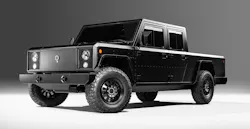
In 2022 Bollinger Motors will offer the B2, an all-electric chassis platform primarily targeting the medium-duty fleet truck market with a high-performance, all-wheel-drive model that is well-suited for mining fleets and firefighting applications. Priced around $100,000, the class 3 (GVWR of 10,001-14,000 pounds) B2 is distinct from Ford’s F150 Lightning and Rivian’s R1T trucks (both class 2A, 6,001-8,500 pounds) that have lower weight carrying capacity and less power and torque. The company also has plans to offer the B1 SUV.
The B2 truck and B1 SUV feature hydropneumatic suspension, geared axle hubs, and up to 20-inches of ground clearance. Batteries offer a range of up to more 200+ miles under a light load and 70-100 miles under any load or road conditions. According to company CEO Robert Bollinger, “Our battery packs are built more for power than for range. What's needed in commercial trucks is the power to accommodate the stopping and acceleration needed to move heavyweights." While a 70 to 100-mile range isn’t much, it’s ideal for delivery trucks that return to the same location at the end of each day. Electric power for the B2 is rated at 614 horsepower and 668 pound-feet of torque. With no load, the estimated time from zero-to-60 mph in 4.5 seconds.
Bollinger has no plans to build or acquire its factory but instead will work through contracted manufacturing operations for vehicle production. The company has letters of intent to purchase from fleet owners and pre-orders with deposits from consumers. Bollinger Motors plans to begin producing its first vehicle offerings in late 2022.
F-150 Lightning
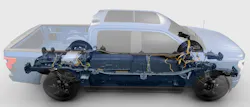
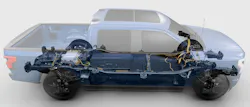
Even though Ford was upstaged by Rivian when it became the first EV pickup for sale, the F-150 Lightning made a splash in June of 2021 with 100,000 pre-orders. Ford will build 15,000 in the spring of 2022 and is scheduled to build 80,000 by 2024. Ford anticipates that demand for the Lightning will be high, as it was designed to appeal to traditional truck buyers instead of the typical well-to-do, “save-the-Earth EV” marketplace.
Some preliminary specs for Lightnings with the standard battery are 426 hp and 775 lb-ft. of torque and an estimated 230-mile driving range. A large battery option increases the horsepower to 563 (775 lb-ft. of torque) and a 300-mile range. The towing rating for the Lightning is 10,000-pounds and the payload capacity is 2,000-pounds.
Ford is developing technology for the Lightning including an automated trailer hitch alignment feature that uses a weight-scale measuring system to help the operator load the trailer for optimal tongue weight, and even provides instructions to move the trailer load forward or backward for a safe towing experience. In addition, to improve handling, the Lightning has independent rear suspension, replacing the F-150’s live rear axle. Another innovative feature is Pro Trailer Backup Assist that uses the twist of a knob to indicate what direction the trailer should go when reversing, reducing the mental effort of steering in the “wrong” direction to get the trailer to end up in the desired position.
One of the most amazing things about the F-150 Lightning is the price. The base price for the entry-level model (before any federal EV tax credit) is $39,974, with the Lightning XLT model costing around $52,974. The EV tax credit of $7,500 is an incentive to buy, however, the specific amount is a moving target and depends on the purchaser's tax status.
The Ford F-Series pickup truck has been the best-selling truck in the U.S. for 44 years, and Ford’s gamble that the Lightning will continue to boost sales showcases the company's commitment to the future of electric vehicles. Ford is investing $30 billion up through 2025 in new plants, research and development, and worker training in the belief that 40% of U.S. automobiles will be all-electric by 2030.
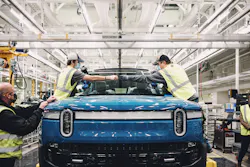
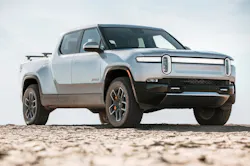
Rivian R1T Pickup Truck
The last pickup in this article is the first to be available to the U.S. EV truck market. On September 14, 2021, the first Rivian R1T pickup truck completed assembly at Rivian’s plant in Normal, Illinois. Rivian is also working on the R1S, an electric SUV. For sales in all 50 states, the R1T still has to receive certifications from National Highway Traffic Safety Administration, the Environmental Protection Agency, and the California Air Resources Board.
Rivian hopes to take a chunk of the EV market away from Tesla and other manufacturers. Backed by Amazon, the company has raised more money than any other private EV startup, and the 100,000 orders of custom delivery vehicles from Amazon will surely help.
With a base price of $73,000, the Launch Edition of the R1T will travel 314 miles on a full charge from its 135-kWh battery. A larger battery pack in the works will deliver about 400 miles of driving. Powered by a quad-motor drive (one motor per wheel), the motors deliver instant power and offer substantially better torque control than locking differentials, as they are independently adjustable for any condition. The front axle's total horsepower is 415 (413 lb-ft. of torque) and in the rear’s is 420 horsepower, with 495 lb-ft. of torque. Towing capacity is 11,000 pounds, but expect around a 50 percent reduction in driving range towing a large trailer.
Plenty is going on in the the 1,760-pound-payload-capacity truck bed that can fit 4 x 8 sheets of plywood. The bed is wear- and corrosion-resistant; features two 120-volt outlets; has a lockable weatherproof, powered tonneau cover; built-in cooler; under-the-bed storage for a full-size spare, and a tailgate that is controlled through a phone app. The R1T even has an onboard air compressor to inflate tires after lowering pressure for off-road driving.
Like Tesla, Rivian is working on company charging stations. The Rivian Adventure Network is being developed and is the company's exclusive DC fast-charging system for use by Rivian vehicles. Additional charging will be provided by the Rivian Waypoints Network (level 2, AC chargers) that will be universally available to other EVs.
Is this the Future of Automobile Production?
At the 2002 North American International Auto Show, General Motors presented its AUTOnomy concept vehicle. The chassis consisted of a six-inch-thick flat deck that housed a hydrogen fuel cell powering four wheel-hub motors. Without a body mounted to the chassis, the vehicle looked like a flat box with four wheels—hence the term "skateboard chassis." The real innovation was that the skateboard could be used for various bodies without redesigning the platform. GM dropped the ball and the AUTOnomy never made it past the concept vehicle stage.
Fast forward to 2013, when REE Automotive started the development of an EV, skateboard platform for future vehicles such as medium-duty last-mile-delivery trucks/vans, e-buses, and e-shuttles. The platform will work for both autonomous and human-driven applications. The REE Automotive concept uses “REEcorners” that house electric motors, power electronics, gearbox, steering, and suspension—all bolted to each corner of the deck (filled with batteries) inside discrete modules. Extending from each module is a stubby axle that supports hub and wheel, steering linkage, brake rotor, and brake caliper.
The flexibility to manufacture different vehicles is unique, because REEcorner modules can be combined to create combinations of the front, rear, or all-wheel drive vehicles with front, rear, or all-wheel steering without reengineering the deck. Transitioning an REE platform from a Class 3 vehicle with a GVWR of 14,000 pounds (equivalent to a Dodge RAM 3500) to a Class 1, with a GVWR of 6,000 pounds (think Ford Ranger) requires just swapping the REEcorner modules for each type of vehicle.
Fleet operators have to maintain large part inventories to service traditional vehicles. This would not be the case with an REE vehicle. REE co-founder and CEO Daniel Barel said, "It takes less than 60 minutes to replace a corner with a brand-new corner. There are no more repairs. There's nothing. Put it up, replace the corner, put the vehicle back to work, send us back the corner, we'll fix it for you and send it back to you.” Fleet operators would need to stock only the REEcorner modules for their vehicles, saving millions of dollars in inventory. REE plans to set up a network of facilities where a vehicle owner could drive in to have REEcorners swapped, as well as a network of repair centers where REEcorners could be serviced or rebuilt.
REE has signed a preliminary agreement with Indian conglomerate Mahindra to manufacture vehicle bodies and interiors. REE will produce its platform and assemble the final product in local-market integration centers. Austin, Texas, will be the site of the company’s U.S. headquarters and its first integration center. REE Automotive hopes that modularity, and ease-of-repair for its mass-produced global market vehicle, combined with lower operating costs for fleet owners will make it a success. While REE's modular concept is currently being applied to the fleet, delivery, and public vehicles, it's not too much of a stretch that future passenger cars and light trucks could follow this business model.
About the Author

Tracy Martin
Tracy Martin writes for Motor Age, Aftermarket Aviation Defense, Contact! and Turbo Diesel Register magazines. As an ASE certified master technician and consultant, he has worked in the automotive aftermarket for over 25 years and has provided consulting services for Snap-On Tools, Sun Electric, Chevron Oil and Nissan of North America. He has developed automotive/powersports curriculum and taught courses including: engine performance, automotive electronics, fuel injection, ABS braking systems and advanced motorcycle riding techniques. He has also provided consulting services as an expert witness for automotive and powersports-related court actions.
He is the author of five books: How to Diagnose and Repair Automotive Electrical Systems, Motorcycle Electrical Systems–Troubleshooting and Repair (two editions), How to Use Automotive Diagnostic Scanners (two editions) and How to Modify Motorcycle Fuel Injection, all published by Motorbooks International.