Making a big dent in your sales
Do you purposely spend very little time calling on body shops? Feel a bit intimidated by their unusual tools and equipment? Don’t think there’s any money to be made?
You may be passing up one of the best new business opportunities on your route.
Body shops need the same items you sell every day: hand tools, power tools, personal gear and more. But it’s selling their unique tools and equipment that earn you a lion’s share of sales that other mobile tool dealers aren’t going after.
The body shop market is much bigger than it looks. And changes in insurance metrics, business models and technology are shifting things in your favor.
Q: Aren’t body shops just a small niche?
A: There are more than 34,000 body shops across the country says Todd D’Angelo, vice president of U.S. Sales for MEDCO and a 40-year body shop veteran. Considering there are 79,000 general repair shops in the U.S., that’s one body shop for every two repair shops on your route.
But the dollars make the difference in this comparison. The average body shop brings in a whopping $798,559 a year compared to just $481,347 for the average auto repair shop (Source: 2016 Auto Care Association Factbook). So, the average body shop rakes in $317,000 more annually than it’s repair shop cousin.
That doesn’t sound small to me.
If you’re not getting your share of body shop tools sales, you’re really missing out.
Q: Don’t they already get their tools from a PBE jobber? Why do they need me?
A: First, that’s poor reasoning. Following that logic, if your competition sells to a shop, you should stop calling on them. Competition shouldn’t turn you off, it should make you want to fight harder for those sales.
Secondly, PBE jobbers may be good at what they do. But, their focus is selling consumable stuff like paint, solvent, sandpaper and masking. That’s order taking.
Your big advantage when calling on a body shop: you’re a tool expert. You’re a wealth of information. And most importantly, you are a salesperson.
Q: Body shop tools are weird. I don’t understand them.
A: OK. So you’re not an expert in body shop tools - not yet at least. But they don’t need to know that. Think of it like when you started your route.
With a little work, you can learn enough to ask the right questions. After all, you only need to know enough to sell the tools, you don’t need to be able to use the tools.
Take the time to get educated. Look to body shop tool manufacturers’ literature, websites and training videos to get knowledgeable. Then, find a body shop you can lean on to fill in the gaps.
And keep the manufacturers’ hotlines handy so you and/or your customer can get any needed details. Spend a bit of effort working at it, and in no time you’ll be up to speed and it will all come naturally.
Q: I’ve called on body shops. Those techs don’t buy anything. It’s a time waster.
A: You’re right - in part. The average body shop tech (the “bodyman”) has a much smaller collection of tools than your repair shop technician customers.
But that’s changing.
“Most body shop work is done through insurance,” says D’Angelo. “Insurance companies are starting to measure body shops on cycle time, that is how fast they’re getting the cars back (to the owner).” Currently cycle time averages about 11.5 days. Every day a shop can shave off cycle time saves the insurer rental costs. This creates a happier insurance company and more insurance referrals for the shop.
So, the body shop employee isn’t the big customer here. They may never buy as much as a repair shop tech. But the body shop owner or manager may buy more shop tools and equipment from you than a general repair shop.
Q: Don’t body shops farm out mechanical repairs? So they need fewer tools.
A: Traditionally, body shops didn’t have all the tools or talent needed to do mechanical work, says D’Angelo. So, they’d sub out work to local shops or dealers. But this can add a day or more to cycle time.
“A lot of the smarter shops, to reduce their cycle times, are now doing more in-shop repairs,” says D’Angelo. And this translates into the need to get tools for jobs like resetting airbags, fixing A/C systems or even basic diagnostic work.
Some shops are hiring dedicated technicians to do mechanical work. This keeps the workflow flowing, contains costs and can put a little extra cash in the coffers. That technician needs many of the same tools as any general repair shop tech.
However, many body shops currently get their specialty tools from a local parts store, says D'Angelo. Service and follow-up fall far short of a tool professional.
"A mobile guy can provide a lot of value by just coming to the shop," says D'Angelo. "Shops need to reduce cycle time. The mobile guys can help reduce cycle time. If they just get in the shop, I think they could have some great success."
A few minutes talking to shop management about tools can open doors.
Q: What should I promote? What are the top-selling body shop tools?
A: First and foremost, sell what you already know.
Get the bodyman and management out to your truck to look around. They need hand tools to disassemble and reassemble vehicles. So, promote your favorite wrenches, ratchets and drivers. And they use a lot of power tools. Demo your best-selling air tools like impact wrenches, DA sanders and polishers. They all need personal gear. Show them safety glasses, gloves, footwear and the rest.
“A lot of times these guys run out to Lowes and Home Depot and buy tools there,” says D’Angelo. Think about that. You’re driving right past these shops and they’re buying tools at a big-box store across town instead of getting professional service from you without having to leave their shop.
You asked about top tools. But that’s a hard number to get since a lot of that business is currently going to parts stores, big-box retailers and PBE suppliers. So, rather than top tools, I decided to look at the most overlooked opportunities.
Six Body Shop Tool & Equipment Segments
Here are five body shop tool and equipment segments to promote according to MEDCO’s D’Angelo (and one from me). Some items you may know already, the others are body shop specific and you’ll need to bone-up on:
- Aluminum Repair – As aluminum vehicles like the new Ford F-150 get in accidents, the shop will need the tools to fix them. I-CAR (i-car.com) provides aluminum-welding training and certification. You just need to provide the tools. This is a brand new field and a wide-open sales opportunity.
- Plastic Repair – Since the early 1980s, companies like Polyvance (polyvance.com, formerly Urethane Supply Company) provide tools and equipment for repairing plastic bumpers, grills, dashboards, fan guards, radiators and overflows. This is a shop equipment purchase with on-going supply sales. (I-CAR also offers plastic welding and plastic adhesive training.)
- Air Bag Resetters – More and more body shops are buying resetters. You may have sold many of these to repair shops and already know enough about them.
- Air Conditioning System Repair – Front-end collisions often damage the A/C system. Mobile A/C requires a bit of training for the technician, but you probably already sell A/C tools and equipment and know enough to sell them.
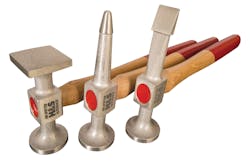
- Body and Trim Repair – Specialty trim kits, dent pullers, body hammers and dollies are a bodyman’s stock-in-trade. Just listing them could take a full page. I suggest handing a catalog to your customer and letting them lead the way.
- Paintless Dent Removal (PDR) – PDR is a small niche. It requires extensive training and talent to do well. It’s mostly used to fix hail damage. I added this to the list because although a small segment, it requires a lot of specialized tools.
There are many other tools like spray guns, clamps, plasma cutters, air compressors and welding equipment that I haven’t even touched on. But this should give you a solid launch pad. The key is to start somewhere and grow from there.
Q: Body shops don’t talk the same languages I do.
A: See my “Crash Course in Collision Repair” mini-glossary in the sidebar to get up-to-speed on the jargon. Every niche has it’s own lingo. Don’t let it intimidate you.
Just remember, you’re not alone if you have minimal body shop sales. But that just means you have less competition and more opportunity. Insiders tell me there is a lot of room for growth.