Anything but a soft launch: AAPEX and AWDA conference blast off as reengaged industry venues
Seriously, Auto Care Association, the gathering in San Antonio in September was anything but a soft launch.
As this column goes to press, the ACA has thus far already ignited an ambitious agenda.
AAPEX and the automotive warehouse distributors (AWDA) conference have since blasted off with the aim that these events will reset the industry as a reengaged venue to conduct business.
But in the works, seven weeks earlier, Auto Care Association president Bill Hanvey and his crew were already firing up the concept of a “soft launch” at the trade group's autumn meeting. As we prepared to fly to San Antonio that September 21 evening from Washington D.C.'s Dulles airport, I saw Bill Hanvey bound into the cabin, while his five associates and I buckled into our seats. So much for a gentle ascent.
Symbolically, Hanvey's vision for the automotive aftermarket went airborne before an enthusiastic crowd at the San Antonio conference about why the $400 billion industry is an essential contributor to the U.S. economy. Now with COVID-19 seemingly contained after nearly a two-year hiatus of in-person gatherings, Bill Hanvey deservedly earned a rousing applause for encouraging the conference-goers to attend AAPEX and AWDA. Particularly, Hanvey's call to action crystallized in other ways too: Carry the message home that it's time for the 4 million-person industry to speak with one voice.
OK, Bill, I will oblige you, if you don't mind!
Three issues hit home, specifically regarding consumers' right to decide who can fix their motor vehicle. Both my past employers and current stakeholders depend on supplying replacement auto parts to independent commercial automotive installers who in turn, keep their customers' personal transport operational.
Despite Massachusetts voters giving an overwhelming 75 percent approval in the November 2020 referendum to enhance the Right to Repair law, the automakers sued. Now the state court is deliberating judgment over who wins. If the automakers prevail, the aftermarket shouldn’t retreat.
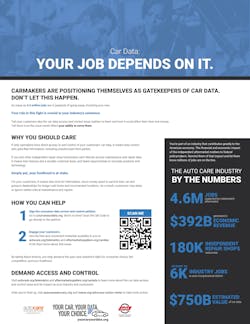
Unsurprisingly and thankfully, the Auto Care Association has stepped up its extraordinary lobbying efforts by bringing the righteous fight to Washington. One handy template letter that comes packaged in a QR code renders it easy for shop owners, jobbers, wholesalers, retailers, and technicians to contact their elected officials directly. With minimal effort, business owners can display the barcode target on the store counter for visitors to point, scan and release to their local politician.
If only scanning at the repair shop level could be that easy, which raises point two about technology. Embedded advanced driver-assistance systems are increasingly commonplace on gas-powered and electric vehicles, which is both an opportunity and a hurdle for independent automotive service providers. For a repairer, ADAS work promises greater sales revenue.
Regretfully, the barriers to obtaining repair data are complicating their efforts to remedy a malfunctioning sensor. Up for debate is how much access to the diagnostic and calibration information is the traditional vehicle manufacturer willing to give away to a non-dealer. Other emerging software companies on wheels, such as Rivian or Canoo, also make the right to service any automobile ever more pressing.
Complicating matters for independent technicians is deciding which ADAS-compatible tool to purchase. Some users allege that many scan tools lack any form of standardization. Most vehicle brands dictate unique pieces of equipment that can interface only with their car and truck models. Until the day comes when one unified scan tool becomes available, techs must be adept at handling a patchwork of technology protocols.
There's no doubt that the Auto Care Association will rise to this task by knitting the ADAS threads into the growing blanket of making the right to service every vehicle a federal law. Bear in mind that independent repair facility owners bear responsibility too by sharing real-life examples with the association. Each example when a shop turned away a customer or went to extraordinary lengths to get vehicle information builds the case why auto dealerships must never monopolize ADAS work.
Thirdly and most currently concerns trade shows. AAPEX 2019 did not disappoint because I found it interactive. The expo was filled with educational meetings, live demonstrations and other sessions purposely designed to help grow the aftermarket business. Alas, did I forget networking events?
Impersonal virtual platforms such as Zoom brings limited human bandwidth. Subscription-free elbow tapping, face-to-face interaction fosters collaboration. Anyone who stayed away from the fall leadership day conference—replete with safety measures throughout the hotel—missed out on conversations that could never possibly have unfurled over screen time. Or may I speculate what Hanvey thinks: no cloud-based video conferencing platform can replicate the intimacy of personal interactions.
Apathy and inaction through dwindling participation can poison any industry group. Perhaps the Auto Care Association might cope with a dip in membership revenue or another black swan event that cancels a public event, but not disengagement. And as this column was written in late October, the judgment over whether AAPEX and AWDA were successful hangs in the balance.
Finally, I’ve always treasured the interactive AAPEX features. Compared to 25 years ago, when I accompanied my father, only exhibitors and buyers came to inspect products from a distance. Back then, professional techs roaming the floors were a rarity. Today’s expanded format centers on the needs of the commercial shop in a pro-consumer marketplace unlike in 1996. This progression suggests that leadership was responding to the feedback about the advantages of industry engagement.
Limited involvement yields deadly serious consequences. Avoid it at all costs. Because without active contact with the association at any level, our identity as an essential industry ceases to exist.
If our industry were to falter, causes like the "Right to Repair" legislation would have no launchpad to blast away and stay aloft.
Thank you, Bill, for your inspiration. We're now ready for takeoff.
About the Author

Alan Segal
Alan R. Segal specializes in project management for suppliers, consultants and retailers. He practiced category management for Sanel Auto Parts Co. and Advance Auto Parts before launching his own firm, Alan R. Segal-Best Business Practitioner. He has worked in the auto care industry since 1991. Connect with Alan on Facebook or LinkedIn.