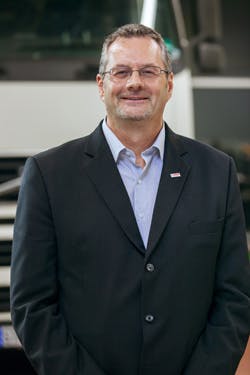
International Newsmaker Q&A Colin Fielding
In 1886 Robert Bosch established his “Workshop for Precision Mechanics and Electrical Engineering” in Stuttgart, Germany. Over the ensuing years his eponymous firm has carried forward the founder’s drive for continued innovation.
Currently the company’s global operations are devoting large sums of funds along with extensive engineering and manufacturing expertise toward developing and perfecting the components necessary for bringing electric vehicles (EVs) into the mainstream automotive marketplace.
Q: What are some of the key electric vehicle powertrain technologies that you are developing?
A: Bosch is investing significant effort in advancing electric vehicles. A new operating unit for electro mobility will bring together all the company’s activities in this exciting area. In addition to the billions invested in improving internal-combustion engines, the company is investing some 400 million euros each year toward achieving a breakthrough in electro mobility. Most of this goes into battery research and development. Bosch is researching both current and future battery-cell technologies.
The company has already won more than 30 electro mobility-related orders. In 2016, it won a further 11 in China alone, the world’s largest market for electro mobility. From the start of 2018, the new Bosch Powertrain Solutions division and its 88,000 associates will offer all powertrain technologies from a single source.
Bosch is focused on electrifying powertrain through technology that provides consumers choice and sustainable performance. Through both OEM feedback and consumer interest, we are seeing that electro mobility is again moving to prominence. We are working to make electrification accessible to the masses so that OEMs can deliver on the promise of this technology to mainstream consumers.
Bosch’s electric axle drive system (eAxle), which debuted at the 2017 North American International Auto Show (NAIAS), makes electrification accessible to automakers through a scalable, modular platform that can bring 5 percent to10 percent cost efficiency as compared to stand-alone components. The eAxle is flexible for multiple platforms and brings together top-of-the-line Bosch powertrain components into one system.
Q: What are some of your systems already being applied to EVs?
A: Braking: In the future, large vehicles in particular will need electrified powertrains in order to comply with ever-stricter consumption limits. The efficiency of these hybrid and electric vehicles will in large part be determined by their ability to recover as much energy as possible while braking. Bosch’s ESP hev is the world’s first series-produced brake control system that coordinates the braking from the wheel and electric motor without the need for additional components, recovering a particularly high proportion of braking energy in the process. The system debuted in mid-2013 in the Mercedes-Benz S400 Hybrid.
Using ESP hev, all the braking maneuvers defined in the New European Driving Cycle (NEDC) can be exploited for energy recovery. The new technology is part of the company's modular brake kit, which offers a customized braking system for any vehicle.
In the S400 Hybrid, the ESP hev coordinates the hydraulic and motor brake torque, and controls the electric vacuum pump of the vacuum-based brake booster. The brake circuit on the driven rear axle is decoupled from the driver’s foot. By deliberately giving the brake pedal greater play, the vehicle can initially be braked solely by the electric motor connected to the rear axle, generating electricity.
The position of the pedal tells the system how much generator torque is needed. If the driver steps harder on the brakes, additional hydraulic brake torque is built up on the front axle in the usual way, so that braking force is now applied to both axles of the vehicle. If the generator cannot provide enough brake torque on the rear axle, the system uses the pump of the hydraulic modulator to build up additional brake pressure. The transitions are smooth and imperceptible for the driver – the vehicle’s behavior and pedal feel remain unchanged.
Along with the version described above for brake circuits with front and rear axle distribution, Bosch also offers a version for diagonal brake circuits. ESP hev can also be used in vehicles with front-wheel or four-wheel drive. The new braking system is based on ESP premium, the most powerful of the variants of Bosch Generation 9.
ESP hev is part of a kit from which we can put together a customized braking system for all vehicles and customer needs, taking criteria such as vehicle size, type of powertrain, degree of electrification, and number of assistance functions into consideration. While ESP hev is the regenerative braking solution for hybrid and electric vehicles, classic ESP continues to be the solution for conventional vehicles.
There are also two brake-booster alternatives: The conventional vacuum-based solution and the iBooster. This new electromechanical brake booster does not need a vacuum, and in combination with ESP hev it can improve energy recovery even further – all the while providing excellent pedal feel. In addition, the iBooster offers the system redundancy that is essential for future automated driving functions. It will go into series production at the end of 2013.
In other words, we offer automakers an unrivaled modular and scalable solution package, which is especially suitable for vehicle models that are available with different powertrains.
Along with the ESP system, Bosch supplies other components for the different models of the new Mercedes-Benz S-Class, including the direct injection systems for gasoline and diesel engines, the display in the middle console, the start-stop starter and the engine’s cooling fan.
Power electronics: Thanks to a new packaging and interconnection technology (PIT), it is now possible to manufacture electronic power modules that operate reliably even at temperatures as high as 300 degrees Celsius. The new PIT is the outcome of the recently concluded three-year Hot Power Connection (HotPowCon) research project, which received funding from the German Federal Ministry of Education and Research. Since control electronics have to cope with very high operating temperatures, especially in hybrid and electric vehicles, the new PIT will serve as an important foundation for the further development of electro mobility in Germany.
Electronic power modules such as inverters, DC/DC converters, and battery chargers are key components in electric vehicles. To push electro mobility into the mainstream, the automotive industry needs power modules that are as inexpensive, energy efficient, and compact as possible.
It also has to be possible to integrate logical entities such as microprocessors into the modules in order to enhance their functionality. Until now, there was no lead-free, reliable, and inexpensive PIT that was suitable for these combined logical power modules and could withstand their high operating temperatures.
Existing joining techniques were either extremely expensive or used lead-based solders that harm the environment. What is more, power modules required complex cooling processes to manage the heat they generate as a result of working with high electrical output. The choice of joining technique determined the upper limit to their operating temperature.
The HotPowCon consortium has now developed a system of workable tin-based pastes that permits joining by way of isothermal solidification. This means all the module’s components can be soldered in a single joining process. The new PIT is lead-free and based on inexpensive materials. Because it can withstand very high temperatures, it greatly reduces cooling requirements. That in turn reduces power consumption and helps to cut costs. In their work on this PIT – choosing what materials to use and developing the necessary process and plant technology – the researchers paved the way for it to be used in industrial series production. They used demonstrators to show that the PIT is reliable at high temperatures.
HotPowCon brought together large companies, medium-sized enterprises, universities and research institutions. Robert Bosch led the project, and partners included Siemens, Heraeus Materials Technology, Chemnitzer Werkstoffmechanik, Seho Systems, the Institute of Applied Systems and Circuits at the University of Rostock, the Center for Microtechnical Production at the Dresden University of Technology, and the Fraunhofer Institutes for Reliability and Microintegration IZM and for Electronic Nano Systems ENAS.
Daimler AG and Volkswagen AG were associate partners. The German Federal Ministry of Education and Research provided around half of the project’s budget of 5.5 million euros, funding the HotPowCon project as part of its “IKT 2020” research program. The newly developed PIT is also suitable for use in manufacturing inverters for photovoltaic systems, and will find application in other sectors in the future
Thermal Management: Bosch technology efficiently manages heat flow in electric vehicles and extends their range by up to 25 percent, especially in winter driving conditions. The holistic thermal management approach for electric vehicles makes heating in the winter and cooling in the summer cost effective and energy efficient.
Q: How do you assess motorist acceptance of EVs on a global basis? Are there particular nations that stand out as prominent EV marketplaces – present or near-future?
A: We expect roughly 15 percent of all new cars built worldwide to have an electrical powertrain by 2025, while in Europe more than one third of new cars will be partly electrically powered – the majority as hybrids.
For Dr. Rolf Bulander, member of the board of management of Robert Bosch and chairman of the Bosch Mobility Solutions business sector, there is no doubt that electrification “will take combustion engines to new heights.” Vehicles are becoming cleaner and more efficient – and the additional electrification will provide a boost to driving enjoyment.
Q: How do you assess motorist acceptance of EVs in North America?
A: At NAIAS we released new research that showed 62 percent of U.S. new car buyers believe they will own at least one full-electric vehicle in their household within 10 years or less. Of those who anticipate having a full-electric vehicle in their household at any point in their lifetime, 71 percent believe all their household vehicles will be full-electric vehicles within 15 years.
While new car buyers demonstrated a growing desire to purchase full-electric vehicles, anxieties remain pertaining to specific criteria, including purchase criteria as vehicle reliability, distance between re-charging stops, time required to re-charge, new car purchase price and cost of repair/maintenance.
There are considerably high expectations that the auto industry must address. As the research showed, existing new car buyers’ perceptions do not match the current production of and options for full-electric vehicles as well as capabilities of today, particularly in terms of range and time to recharge.
In addition, a significant subset of respondents, 32 percent, indicated they are not interested in purchasing or leasing a full-electric vehicle within the next 15 years, signaling a preference toward other powertrain options.
Q: Are there particular North American cities and/or regions that stand out as prominent EV marketplaces – present or near-future?
A: Yes, the ZEV (zero-emission vehicle) states stand out as major EV marketplaces. This is supported by new vehicles being exclusively for sale in the ZEV states. For example, the Chevrolet Spark EV and Bolt were initially only for sale in California and Oregon, while the Bolt is expected to be available soon in all states.
Q: Are you seeing increased interest among automakers in producing additional EV models?
A: The market is seeing an increased interest in EV production. Automakers who previously have not manufactured EVs are now announcing plans and unveiling concept vehicles based on electric drivetrains. Increased battery capacity and vehicle range makes electric vehicles a good option for many in major metro areas.
Q: What is the scope of Bosch’s North American market for EV replacement parts?
A: Business will be as usual. Everything at electrification including EVs will be handled in the aftermarket just like any other product on conventional vehicles. There are some differences such as the battery having end-of-life at 80 percent of original depth of discharge, the charger, inverter and electric motor components will have a much higher life expectancy than some of the traditional internal combustion engine components.
The reason is that these parts are not exposed to as rough an environment as ICE components are, which include fuel combustion, oil, moving parts and high temperature. Also, the fixed gear transmissions for EV are much simpler and should have a higher durability.
Q: Are drivers patronizing aftermarket repair shops and DIY parts stores? Or are most repairs and parts purchased from dealership service centers?
A: Currently, it seems drivers are more likely to take their hybrids and EVs back to their dealer for service and general maintenance.
Q: Do you recommend that aftermarket repair shops begin purchasing the necessary shop equipment and training to repair EVs?
A: As with any new technology, aftermarket shops should be prepared to invest in specialized equipment based on the number of vehicles they see. If a shop has never seen a hybrid or EV for service, it wouldn’t make sense to invest in equipment and training until it becomes a larger part of the car parq in their area. As electric vehicle adoption expands, shops should consider training and equipment options that fit with their needs and the services they expect to perform.
Q: Do you provide EV shop equipment? What are some of the key components needed?
A: Yes, our automotive aftermarket division provides tools and equipment for high-voltage service. Tools and equipment for hybrid or EV service must be able to safely handle the high-voltage systems within an EV, including the AC system.
For starters, an AC recovery, recharge and recycle machine must be tested and rated for high-voltage systems to safely service the system and meet specific SAE standards. Additionally, technicians should wear insulated gloves rated for 1,000V use. Testing the high-voltage systems also requires specialized multi meters capable of reading voltage well above what you’d normally see in an automobile or even a house.
Q: Where do you recommend that EV service managers and technicians obtain the proper training for working on these systems?
There are a number of electric vehicle technician training programs available from respected institutions. We don’t favor one over another but do recommend technicians do their research and look for programs that are in some way partnered or affiliated with a vehicle manufacturer or from a trusted, longstanding technician training program.
Subscribe to Aftermarket Business World and receive articles like this every month….absolutely free. Click here.
About the Author

James Guyette
James E. Guyette is a long-time contributing editor to Aftermarket Business World, ABRN and Motor Age magazines.