Tool Review: Prologics Sensor Simulator and 12V/24V Sensor Voltage Probe
Content brought to you by PTEN. To subscribe, click here.
Q: How did the tools function as far as saving you time?
A: These tools, which are substantially similar in capability, save many unnecessary parts installations if used as designed. For example, too many technicians are content to read a code, say, for a vehicle speed sensor issue on a wheel, and go straight to the recommendation and installation of a wheel bearing with a sensor integral to it. If the problem turns out to be a wiring issue or a module issue, it turns into an ethical dilemma. Who pays for the part that was installed that didn’t solve the problem? Or do I return the part as “defective”? Either way, someone is being cheated and this tool can quickly and easily be used to simulate the signal BEFORE the part is replaced which is a huge benefit.
Q: What kind of setup was involved before using the tools?
A: No setup was required for the tools.
Q: How easy was it to use?
A: The basic functions of the tools are simple to use. Since the tools don’t come with instructions, it seems to be assumed that the user is an experienced technician. As an experienced technician, I found the tools to be pretty easy to navigate, but I think it would be wise to at least include a simple set of instructions.
Q: How was its packaging? Did it come with any accessories?
A: The tools come in a sturdy plastic box which I wish was just a little bit larger as the leads need to be coiled up properly to fit. The only accessories are the voltage leads.
Q: Was there a manual included? If so, did you use the manual, and was the manual easy to understand?
A: No manual was included. I feel they should've at least had a QR code to an online manual or have a YouTube instructions video, if they wanted to go paperless.
Q: What features did you like?
A: I like the backlit screen and the built-in flashlight on the one model. Since I’m an automotive instructor as well, I see huge benefits in using the tool to teach entry level technicians sensor functions without having to deal with the danger of a running engine. It’s also a great tool for demonstrating lab scope functions. I love the versatility of the wide and extremely precise ability to adjust the tool’s outputs. It’s a great improvement over my old sensor simulator tool which used basic potentiometers to simulate signals.
Q: What features didn’t you like?
A: I wish the cases were bigger. The voltmeter/ohmmeter functions are pretty basic so I don’t think I would use the tool for those kinds of functions.
Q: What types of jobs/repairs did you use these tools for?
A: I used them on a 2021 Chevy Silverado 1500 with P0521 and P0522 codes. The oil pressure indication on the scan tool varied wildly. Rather than replace the sensor and hope that was it, the simulator tool connected to the pigtail output a specific voltage, which should have resulted in a steady pressure reading on the scan tool. It didn’t, which proved the problem was not the sensor. The problem was in a chaffed harness causing the signal wire to ground out and reading 0 psi when the actual oil pressure was completely normal.
I also used the tools on a 2010 Toyota Camry with a variable displacement compressor. Using the tools to simulate the signal going to the compressor proved the problem was in the command to the compressor and not the compressor itself.
Q: Is there any way you could think to improve or add to these tools?
A: I would add an instruction sheet or, in lieu of that, a QR code linking to web-based instructions. The tools are not hard to figure out, but I think it would be difficult for a beginner to master.
Q: On a scale of 1 to 10, how would you rate these tools overall? Why?
A: I give them a 9. If parts companies could convince technicians to use these tools in lieu of installing parts that may not be needed, the savings in returned parts would be enormous. As an automotive instructor, I can see almost endless possibilities to use this tool in a lab-type teaching environment.
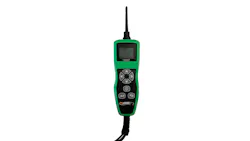
The Prologics Sensor Simulator is designed to simulate and actuate an output signal from automotive sensors incorporating frequency, voltage, and test sequences. The Sensor Simulator lets the technician know if the faulty operation is a defective sensor, an issue with the ECM / ECU, or a defect in the wiring. It can simulate ABS sensors, lambda sensors, EGR, CKP, MAP, knock sensors, and more. The tool saves technicians time by eliminating the problem quickly.
The 12V/24V Sensor Voltage Probe by Prologics can emulate signals generated by different types of sensors in a vehicle. Simply set the output voltage to the correct value and activate it with either 3A or 150mA on a permanent output or with a switch. Whether checking the component independently or using a diagnostic scanner, this voltage probe is designed to make it easy to identify if the fault lies in the sensor or its connection. The Sensor Voltage Probe can also be used to measure resistance up to 5K ohms.
About the Author

Phil Fournier
Phil Fournier has been the owner/technician at Phil’s Auto Clinic for 32 years and a working auto technician for 45 years. Fournier received his ASE Master Certification in 1982 and his AAM from the Automotive Management Institute in 1994. Currently, he works as a consultant doing diagnosis, reprogramming, and virtual instruction. Fournier currently holds 17 ASE certifications including ASE Master Auto and Master truck plus L1, L2, and L3.