Interstate expects fuel cost savings while promoting a cleaner environment
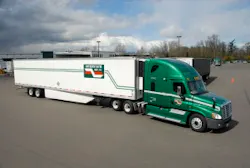
Interstate Distributor, Freight Wing and the Pacific Northwest Pollution Prevention Resource Center (PPRC) have announced the beginning of one of the industry’s largest installations of trailer side skirts.
Partially funded by an $875,972 grant from the EPA’s Diesel Emissions Reduction Act (DERA) in a cost-sharing program, Interstate has begun installing 2,058 Freight Wing Aeroflex side skirts at its maintenance facilities.
Headquartered in Tacoma, WA, Interstate Distributor is North America’s 12th largest truck load carrier, and 46th largest for-hire carrier, with a fleet of more than 2,000 tractors and 6,800 trailers.
“We greatly appreciate this opportunity presented to us by the EPA, and to work with PPRC and Freight Wing,” said Lee Owens, senior vice president of maintenance and facilities for Interstate Distributor Co. “We expect great success with the project.”
“The Freight Wing side skirts give a lot of bang for the buck when it comes to reducing fuel consumption and emissions,” said Owens. “We’ve tested the side skirts for the past few years and have seen up to a five percent improvement in fuel economy depending upon the route and the speed we’re traveling. The higher the average speed, the better the performance.
“We also tested durability, a huge factor for us in deciding which side skirts to purchase. We chose the Freight Wing product because it was more resilient than others we tested.”
The side skirts are constructed of durable plastic panels, combined with a flexible bracing system designed to absorb and deflect both ground and side impacts.
All told, Owens said that without the EPA grant, Interstate Distributor would be seeing a return on investment of less than two years. With the grant, the time is cut by a third.
“We think it’s a great thing that the EPA is stepping up to help companies implement fuel and emission savings technology,” he said. “Everyone wins and we hope grants continue for our industry to help the trucking community and the environment.”
Sean Graham, president of Freight Wing, said the company’s Aeroflex side skirts reduce aerodynamic drag by preventing wind from hitting the trailer’s wheels and axles. They have been EPA SmartWay verified and tested to increase fuel economy by seven percent in independent SAE/TMC J1321 track testing conducted by Energotest 2008.
“Track tests are done in a controlled environment at constant highway speeds. In the real world, results can vary due to different average speeds, applications and driving environments,” he said. “Fleets and owner operators typically see anywhere from four to seven percent improvements, with high mileage applications getting the best results.”
According to PPRC, the Interstate Distributor project is expected to save 1.1 million gallons of diesel a year and more than 16 million gallons over the lifespan of the skirts, while preventing 182,633 tons of greenhouse gas emissions.
Dennis McLerran, EPA regional administrator in Seattle, said the PPRC offers both health and economic benefits to local communities when they help make trucks more streamlined and fuel-efficient.
“These aerodynamic upgrades reduce fuel consumption and save money,” he said. “By helping fleets update their vehicles, PPRC, through the DERA grant, provides much-needed assistance to the transportation industry, while reducing diesel pollution health risks in the communities it serves.”
Interstate Distributor’s Owens said the company will continue to outfit its remaining long-haul trailers with side skirts after this project is completed. “The benefits are too big to ignore,” he said. “We see the future for aerodynamic technologies as a key ingredient for reduction of green house gases and reduction of carbon footprint.
“Our plan is to be 100 percent compliant with the CARB mandate as it is presented now.”
The implementation of side skirts is a continuation of forward thinking by Interstate, which has a long history when it comes to improving productivity and fuel economy.
“We were quick to join the SmartWay initiative, becoming members in 2004,” Owens said. “Over the past five years we’ve seen overall fuel economy improve by more than one mile per gallon to the high six’s. We run aerodynamic models from Freightliner, Volvo and Kenworth equipped with power and drive train components to maximize fuel efficiency.”
In addition, the Interstate Distributor fleet runs with low-rolling resistant tires and has idle reduction technology on board to lower idling rates. The fleet has implemented engine shut down parameters after five minutes of idle when a truck is equipped with an APU or shore/battery power that takes over heating/cooling duties from the main engine.
“On our APU-equipped units we average 5.09 percent engine idle time,” said Owens.
The company is also committed to driver education.
“We have peer groups and we closely monitor driver performance through telematics and engine data tracking,” he said. “In prior years, the gap between our best driver and worst driver in fuel economy would exceed one mpg. “But since we began monitoring, and mentoring through our peer group, that gap has closed significantly.
“If you implement fuel-saving technology, correct equipment specifications and couple that with solid driver training, you will maximize fuel economy.”