Direct Hit Number: 420988
Vehicle Application: 2003 Malibu, 3.1L engine
Customer Concern: Constant misfire on #6 cylinder: has good spark, switched injectors and plugs, good lab scope pattern on the injector compared to the other cylinders. It has good compression and no vacuum leaks. Carbon treated the engine, no signs of valves hanging in the guides.
Average Reported Mileage: 81,989
Tests/Procedures:
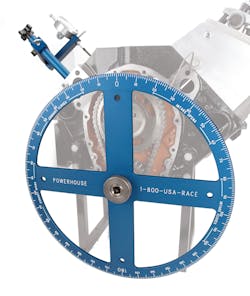
- Check for a slipped cam lobe by using a dial indicator and a degree wheel on the crank pulley.
- Measure and note at what degrees both the intake and exhaust valves start to open.
- Compare these readings with a good cylinder, they should be identical. If not, replace the cam shaft.
Tech Tips:
Most often when a slipped lobe is experienced, the engine had been overheated prior to the event. Verify the intake manifold or head gaskets are not leaking coolant. The camshaft is a hollow tube design with pressed on lobes.
Tools used for this diagnosis:
- Dial indicator
- Degree wheel
- Compression tester
- Leak down tester
- Smoke machine
- Vacuum gauge
When diagnosing engine power loss or other driveability issues, mechanical problems are not the most common cause. But after ruling out ignition and fuel injection problems, checking the mechanical condition of the engine is the next logical step. Most techs would start by looking for a vacuum leak or compression leak, but the Tech Tip also points to a valve timing problem. Let’s take a look at some of the tools for these tests.
Smoke and Vacuum
Originally developed for finding Evaporative Emissions (EVAP) System leaks, diagnostic smoke is also the easiest way to find a vacuum leak. In fact, it’s so easy that many techs overlook one of the oldest and most basic diagnostic tools: the vacuum gauge.
Although this engine has no vacuum leak, a vacuum gauge will also indicate a cam timing problem. If overall cam timing is late, intake manifold vacuum will be low. If there’s a valve timing or sealing issue with only one cylinder, the vacuum gauge needle will pulse at idle. If there are no mechanical problems big enough to cause a constant misfire, the needle will be stable and vacuum will be about 18 inches of mercury (in.Hg) or higher at idle.
Using a Degree Wheel and Dial Indicator
A degree wheel and a dial indicator are used along with engine mechanical specifications to check valve lift and timing. It’s not always easy to find valve opening specs, but here we only need to compare valve timing for cylinder number 6 with another cylinder that’s firing correctly. On this engine, the firing order is 1-2-3-4-5-6, so it’s easiest to compare cylinders 4 and 6 because only one valve cover need be removed.
With the degree wheel mounted on the crankshaft, rotate the crankshaft in the normal direction of rotation until number 4 piston begins moving up on the compression stroke. Stop at Top Dead Center (TDC) and note the degree wheel reading. Since you’re just checking valve timing against another cylinder, it’s OK to watch the rocker arms to determine TDC. To get an accurate valve timing measurement, you would find the exact TDC using a piston stop tool.
Set up the dial indicator on the exhaust valve rocker arm and zero the indicator. Rotate the crankshaft in the normal direction until the dial reaches its highest reading. Check the degree wheel and make a note of the reading. Move the indicator to the intake valve and repeat the process. Now you know the valve lift for cylinder 4 and, more importantly, how many degrees before or after TDC those maximum lifts occur. Repeat the process on cylinder 6. If the camshaft lobes have slipped, maximum lift will occur a different number of degrees before or after TDC. If there really is a slipped cam lobe, the difference will probably be significant.
Compression Test
A standard cranking compression test will tell you if a cylinder is leaking compression. A wet compression test (squirting oil in the cylinders) will tell you if compression is leaking past the rings due to fuel flooding. However, neither test will find a slipped cam lobe because there is no compression leak. But a running compression test will show how effectively a piston pumps air in and out of the cylinder; the cylinder’s volumetric efficiency. This would be affected by incorrect valve timing.
For this test you need a compression gauge that has a release valve. First remove all the spark plugs, do a standard cranking compression test and record the readings. All cylinders should be within 10 percent of each other.
If the car’s battery is low, use a jump pack or a battery charger that has an engine-start mode. Don’t forget to keep the throttle wide open. This not only improves accuracy, it also puts the fuel injection system into ‘clear-flood mode’ to prevent the injectors from operating.
Leave the compression gauge installed in the problem cylinder and install the remaining spark plugs. Some techs prefer to remove the gauge’s Schrader valve for this test, but it’s not necessary. With the engine running at idle, briefly press the gauge’s release valve to ‘burp’ the gauge, then let it close again. The reading should stabilize at about half the cranking compression. Quickly snap the throttle wide open and then release it. The reading should increase to about 80 percent of cranking compression. Repeat this test on the other cylinders and record the readings.
Low running compression, particularly in the snap-throttle test, indicates an intake restriction. High running compression indicates an exhaust restriction. The readings for all cylinders should be about the same. If a cam lobe has slipped, running compression will be high or low on that cylinder, and you’ll know whether it’s the intake or exhaust lobe.
All of these compression tests can also be performed with a pressure transducer and oscilloscope. Instead of comparing lists of numbers, you can see the results graphically, store them and even print them.
Leak Down Testing
A leak down test is a static test that will show where a cylinder is leaking. The tester uses a gauge to measure input air pressure and a second gauge to measure the pressure inside the cylinder. The difference between the gauge readings indicates the percentage of air pressure leaking out of the cylinder. If supply pressure is 100 psi and the cylinder can hold 85 psi, that indicates 15 percent leakage. Some techs use only 50 psi for this test because lower pressure reduces the risk of pushing the piston down, and it’s just as accurate. However most techs use 100 psi, probably because it's closer to the engine’s cranking compression. It makes the math easier too.
The piston should be at TDC and on the upstroke so the rings have the best opportunity to seal where they normally do on the piston ring land. Ten percent leak down for each cylinder is acceptable, and it will be hard to tell where the air is leaking out.
If leak down is greater, listen at the tailpipe, at the throttle opening, and at the oil filler to determine whether air is leaking past the exhaust valve, intake valve or rings.
When looking for engine mechanical problems serious enough to cause a driveability issue, the tools and techniques haven’t changed much over the years. But such problems have become rare enough that the diagnosis is becoming a lost art. It helps to keep in mind what’s happening inside that engine, and keep notes of all your test data too. Sometimes experience is the best tool you can have.
A piston stop tool prevents the piston from moving to the top of its stroke. Remove the sparkplug and make sure the piston is not at the top of the cylinder. Install the stop tool, then rotate the crankshaft until it stops. Note the degree wheel reading, then rotate the crankshaft the other way and note the degree reading where it stops again. Half way between those two readings is the exact TDC.
About the Author

Jacques Gordon
Jacques Gordon is the former editor-in-chief of PTEN and Professional Distributor magazines. His background includes 10 years as an automotive technician and 10 years in Tier 1 suppliers’ engineering labs testing gaskets, fuel injection systems and emission control systems.
He continues to stay abreast of the latest technical developments through editorial research and technician training seminars. He holds an ASE Master Technician with L1 Certification and a Master Hybrid Technician certification from ACDC.
Jacques has been writing for aftermarket magazines since 1998, and he has earned a reputation as one of the best technical writers in the business. He is a winner of two American Society of Business Press Editor awards and several company editorial awards.
He is currently the video script writer for the CARS Training Network in Ontario, Canada.
Connect with him on LinkedIn.