TPMS Roll Out Opens a New Window of Service Opportunity
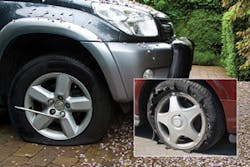
In April 8, 2005, the National Highway Transportation Safety Administration issued its final rule on Tire Pressure Monitoring Systems. It became the outgrowth of Congressional action following widespread rollover accidents with SUVs attributable to under-inflated tires. NHTSA concluded that if motorists were alerted about low tire pressure through TPMS technology, as many as 79 deaths and 10,365 injuries could be prevented each year on American roads. The regulations relating to all of this are full of countless details and bureaucratic jargon, so we'll spare you that.
But here is the straight scoop on what TPMS technology means to you today in the service bay.
WHERE DOES TPMS APPLY?
By law, manufacturers of vehicles sold in the U.S. below 10,000 lbs. gross vehicle weight are required to have TPMS technology onboard. Its mandated application, however, didn't come in one broad brush. Rather, beginning with 2006 models, 20 percent of a manufacturer's models were required to have TPMS. That escalated to 70 percent for 2007 models, and across the board for 2008 models. (It's important to note that some vehicles prior to 2006 had TPMS as an option.)
As you can see, this quick ramp-up makes it likely that TPMS is already rolling into your shop, and the technology will be on everything you service in the not-too-distant future.
TYPES OF SYSTEMS
Although TPMS on any given vehicle may be made by a number of different companies, the technology itself falls into two different types, indirect and direct. It's important to note the difference:
• Indirect TPMS technology "piggybacks" on a vehicle's ABS, using it to calculate different wheel speeds as detected by the wheel-speed sensors. Theoretically, as tire pressure drops, so does the diameter of the tire, resulting in increased rotation speed. By comparing wheel speeds against one another with the right logic, a determination can be made about low tire pressure. The Achilles' heel to the indirect TPMS is that it can't detect which tire is low, or if all tires are low at the same time. Indirect systems were mainly used on vehicles predating the NHTSA final rule in 2005.
• Direct TPMS employs pressure sensors/transmitters located inside each tire to continuously track air pressure and temperature. Those values are transmitted via radio frequency to a computer for analysis and display on the vehicles' instrument panel. The sensors/transmitters may be mounted to the tire valve stem itself, the rim or the tire. Only direct systems really meet the spirit of the final rule and are therefore the best technology. As a result, direct TPMS can detect which exact tire is low and even if all four happen to be low at the same time.
TPMS OPERATION
By law, TPMS has to perform some key tasks in order to deliver
on the safety improvement goals that NHTSA rolled into its final rule. They include:
• Pressure sensors/transmitters in all four tires (Spare tire monitoring is not required
by law).
• TPMS must be operational whenever the ignition is on and alert the motorist via warning
light when any one of the four tires falls 25 percent or more below the placard-specified
inflation pressure.
• The warning light must stay lit until either proper inflation pressure is restored
or the system fault triggering the warning light has been remedied.
• The TPMS must have a warning light test, activated when the ignition is turned to
the "on" position.
• The vehicle owner's manual must have appropriate information including warnings
about the TPMS, specifically mentioning incompatible replacement tires.
GOT TPMS?
How do you know if the vehicle you're servicing has TPMS?
Obviously, from 2008 forward, it's a no-brainer since all cars have it starting with
that model year. For 2007 and prior models, look for two tell-tale signs.
First, look at the tire valve stems and see if they're metal and retained with a large,
collar-style nut (most direct TPMS use a sensor at the base of the valve stem).
Second, check the instrument panel for an indicator light (usually a U-shaped icon with an
exclamation point inside). This light is the Malfunction Indicator Lamp for the TPMS system.
Look for both metal valve stems and the light because a metal valve stem by itself does not
necessarily mean TPMS onboard.
SERVICE TOOLS AND TIPS
Like any new technology, TPMS also means some new
tools may be in your future. When you consider how entrenched this technology has become
so quickly, you won't want to be left behind.
A TPMS diagnostic tool enables you to diagnose and reset the system. In fact, TPMS also changes
the nature of basic tire service. For instance, you may need to use a diagnostic tool to
communicate with the wheel sensors prior to tire rotation or replacement. Not only does this
confirm that they work properly, it may also be required as the first step of a relearn procedure
so the system can identify each tire. In some cases, a scan tool may also be used for this
procedure. Looking ahead, identify the types of vehicles you service most often and then
speak to your tool and equipment rep.
As with OBD II systems, the MIL on a TPMS has dual purposes. A steady light means that the system detects a low tire, whereas a flashing light means there's a problem with the TPMS itself. A TPMS diagnostic tool or scan tool can yield more details.
Even the simple valve
core has changed when it comes to TPMS. Use only nickel-plated valve cores on aluminum stems
or corrosion may result in the valve core area, resulting in loss of tire pressure.
TPMS is an embedded technology that's here to stay. Why not make it just as integrated
into your shop's service offerings? It'll help bolster customer satisfaction
and can boost your shop's bottom line as well.